
Introduction
Enterprises have relied on SAP software for many years, and today their SAP landscapes hold decades of transactional history, business rules, and process intelligence across S/4HANA, ECC, BTP, and connected systems. Much of that data has been historically siloed and difficult to access, but with the work we’ve been doing with SAP around SAP Integration Suite, advanced event mesh, the data in these silos is now being liberated and exposed to the larger enterprise.
As they deploy AI agents that need to access and interact with this data, however, several significant new challenges arise, exemplified by these five questions:
- How do you build agents that scale beyond prototypes?
- How do you connect agents across different platforms?
- How do you enforce governance and auditability?
- How do you validate each decision an agent makes?
- How do you avoid rebuilding when the tech stack changes?
These questions encapsulate the reasons that enterprise AI initiatives that revolve around SAP and other enterprise software platforms tend to stall out and not deliver the expected ROI. Most agentic frameworks excel at prototyping, but don’t meet the compliance, reliability, and integration requirements of SAP and other truly enterprise-oriented systems. They answer, “can we build something intelligent?” but not “can we run it in production with confidence?” To enterprises, this gap matters.
Solace Agent Mesh closes that gap. For organizations running SAP Integration Suite, advanced event mesh (built on Solace Platform), the architecture will look familiar, Agent Mesh extends patterns you already use.
The Agentic AI Landscape:
From LLMs to Orchestration
Building production-grade agentic AI for SAP environments requires understanding the core technology landscape. The ecosystem spans four essential layers that autonomous systems require.
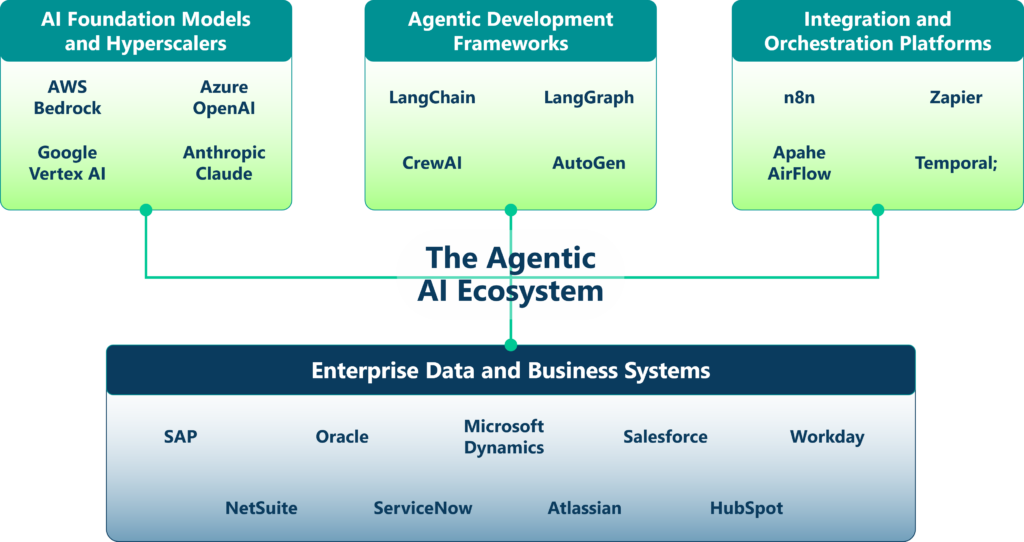
AI Foundation Models & Hyperscalers
At the top of the stack sit the large language models that power agent reasoning. AWS Bedrock, Azure OpenAI, and Google Vertex AI provide managed access to models from OpenAI, Anthropic, Meta, and others.
Key consideration for SAP customers: the choice of foundation model often depends on existing cloud commitments and compliance requirements particularly for European customers subject to GDPR who may prefer EU-hosted models.
Agentic Development Frameworks
This layer provides the scaffolding for building multi-agent systems. LangChain and LangGraph dominate the Python ecosystem, while CrewAI and AutoGen focus on multi-agent collaboration patterns. Microsoft’s Semantic Kernel serves C# and .NET environments common in enterprise Microsoft shops. LlamaIndex specializes in data retrieval and indexing patterns.
The key limitation: These frameworks excel at agent logic but lack native enterprise integration capabilities. They assume you’ll handle connectivity to SAP, security, and event-driven orchestration separately.
Integration & Orchestration Platforms
Tools like n8n, Zapier, and Apache Airflow bridge the gap between agents and business systems. They provide visual workflow builders and pre-built connectors useful for simple integrations but problematic at scale.
The challenge for SAP customers: these platforms typically use polling mechanisms rather than event-driven architectures, introducing latency and inefficiency. A workflow that “checks SAP every 5 minutes” doesn’t meet real-time business requirements and places an unnecessary workload on SAP backends.
Enterprise Data & Business Systems
This is where your business logic and data live. SAP S/4HANA, SAP BTP, Salesforce, and other systems of record hold the information agents need to make decisions. The expanded SAP ecosystem (Ariba, SuccessFactors, Concur) adds complexity; each system has unique APIs, authentication models, and data schemas.
The problem: Most agentic frameworks treat these as external APIs to be called via HTTPS.
The Structural Problem with
Agentic AI in SAP Environments
SAP landscapes are distributed by design, on-premises or cloud ECC or S/4HANA, cloud extensions on BTP, third-party CRM and logistics, plus SaaS tools. Making AI agents work across this estate isn’t an AI problem. It’s an integration problem.
Most generic agentic frameworks promise autonomous decision-making and multi-step workflows. But deploying them in SAP environments exposes a core disconnect between consumer-grade agentic systems and enterprise needs.
Let’s examine these challenges through a common scenario: automating incoming RFQ response workflows.
The Incoming RFQ Agent: Complexity Hidden in Plain Sight
Your sales team receives 200+ RFQs daily via email, supplier portals, and EDI. They want an agent to automate responses:
“When an RFQ arrives, extract requirements, check product information and cross/up selling opportunities in PIM, check inventory availability in S/4HANA, calculate pricing with margin rules, calculate shipping costs and delivery dates based on sourcing warehouse and destination and send it back all within 1 hour.”
This seems straightforward until you map it to your SAP landscape and discover why most enterprise agentic AI projects fail.
Challenge 1: Foundation Models Lack SAP Domain Knowledge
Your agent must interpret unstructured RFQ text (“need 500 units of product SKU : SKF-6206-2Z, ship to Munich warehouse by May 15″) and map it to: material master data in S/4HANA, customer-specific pricing conditions, product attributes in PIM, and warehouse locations for shipping calculations. When the RFQ mentions ” SKF-6206-2Z,” the LLM doesn’t know this maps to material 100234567 with specific pricing procedure ZSTD and related cross-sell items.
The Gap: RAG systems retrieve documents. Your agent needs real-time structured data from SAP tables (MARA, MARC, A304), PIM hierarchies, and customer-specific contracts with relationships intact and authorization context preserved.
Challenge 2: Frameworks Can’t Orchestrate SAP Transactional Workflows
Your workflow requires the following sequential process:

Steps 8-9 are transactional. If quote generation fails after inventory reservation, you must roll back. If credit is blocked at step 4, abort before reserving stock. Your agent needs distributed transaction support, compensation logic, and state persistence (processing may span systems with different response times).
The Gap: LangChain and CrewAI lack long-running workflow state management and intelligent retry mechanisms. While the RAG agent querying a PIM system responds in 5 seconds, the SAP Business Agent Foundation (prototype) agent querying a S/4HANA system might need multiple minutes. LangChain and CrewAI can’t maintain context across these time spans, they timeout, lose state, or retry incorrectly.
Challenge 3: Integration Platforms Create Latency and Data Loss
Using Zapier or n8n means polling-based triggers (5–15-minute delays), HTTP-only connectivity (no RFC, IDoc, or BAPI), and lost business context (customer sales area, pricing group, plant assignment).
Real Failure: RFQ arrives at 9:03 AM, detected at 9:15 AM. Agent queries inventory via REST API but doesn’t see stock reserved at 9:08 AM by another process. Your agent commits to delivery you can’t fulfill. One hour later: “Sorry, inventory is unavailable.” and customer trust is damaged.
The Gap: You need event-driven triggers (millisecond reaction), protocol bridging (email → RFC → REST → EDI), semantic routing (route by customer region), and backpressure handling across systems with different performance profiles.
Challenge 4: Governance and Auditability Are Non-Negotiable
Your agent makes business decisions: pricing, inventory allocation, shipping commitments. SAP requires authorization context: a sales rep approves quotes up to €50K with 10% discount maximum; managers handle up to €500K with 20% discounts. It requires approval workflows, audit trails capturing every decision’s reasoning, and compliance controls blocking sanctioned customers.
The Gap: Generic frameworks use technical service accounts bypassing SAP authority checks. LLM reasoning isn’t logged in SAP. When auditors ask, “Why did we offer 12% discount and premium shipping?”, the answer exists only in framework logs and not in SAP’s audit trail.
These challenges block agentic POCs from reaching production. You need infrastructure designed for this problem.
Solace Agent Mesh
Solace Agent Mesh is a purpose-built orchestration platform that bridges the gap between agentic AI frameworks and production enterprise systems. It provides the event-driven infrastructure, protocol translation, state management, and governance capabilities required to deploy autonomous AI agents at scale in hybrid enterprise environments.
Architecture Overview
Agent Mesh spans three layers:
- Input Layer: Event ingestion from enterprise systems, APIs, and user interfaces
- Processing Layer: Agent orchestration, state management, and workflow control
- Output Layer: Communication with systems, databases, services, and human approvers
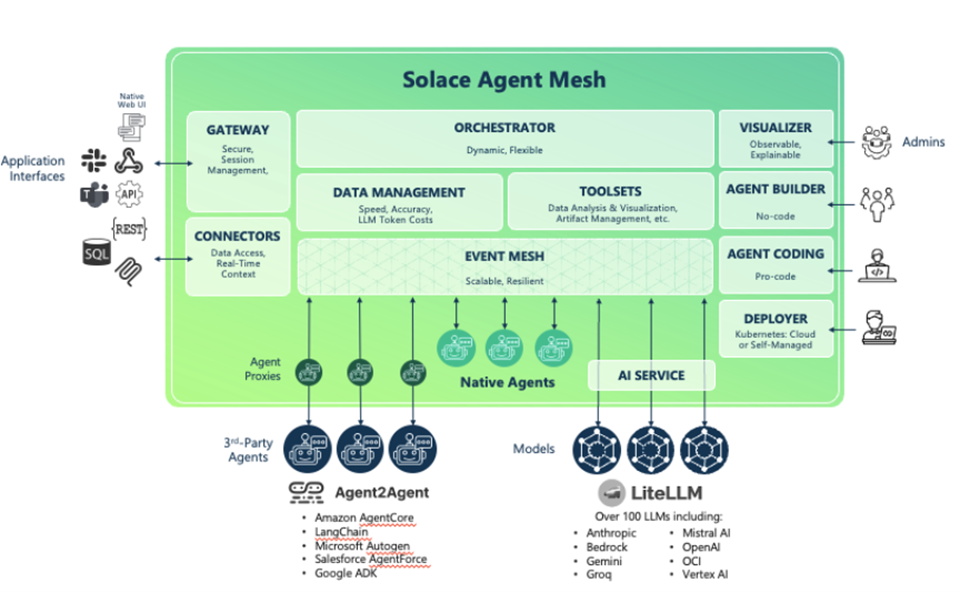
Let’s examine some of the core components that enable this architecture.
Event Mesh
The foundation of Agent Mesh is an enterprise grade event mesh which you can build with Solace Platform which acts as the communication channel between all other components in the agentic environment.
The event broker that sits at the heart of Solace Platform (Solace Event Broker) handles all popular messaging protocols, connects to enterprise systems via built-in micro-integrations, guarantees message delivery with dynamic routing, and processes high-throughput streams with sub-second latency.
Orchestration Engine
Agent Mesh’s orchestration engine manages complex, multi-step agentic workflows:
- Long-running workflows: State persistence across hours or days for asynchronous processes
- Checkpoint and resume: Automatic recovery from failures without workflow restart
- Parallel execution: Concurrent agent invocation with result aggregation
- Conditional routing: Dynamic workflow paths based on agent decisions or business rules
- Human-in-the-loop: Seamless escalation to approval workflows when confidence thresholds aren’t met
Agent Integration Framework
Agent Mesh can integrate with any Agent-to-Agent (A2A) compliant agent, Model Context Protocol (MCP) server, or LLM provider
- Multi-LLM support: Connect to 100+ models across AWS Bedrock, Azure OpenAI, Google Vertex AI, Anthropic, OpenAI
- Dynamic agent selection: Route tasks to optimal agents based on required capabilities
- Agent registry: A growing catalog of Solace-built and community-provided agents with capability declarations and access policies
- Workflows: Build pro-code/low-code prescriptive workflows which will help build deterministic agentic solutions.
Agents remain stateless, but Agent Mesh manages context, history, and coordination.
Data Management & Context Layer
Agents require real-time access to enterprise data and historical context:
- Context enrichment: Automatic injection of relevant business context (customer history, product data, pricing rules)
- Caching layer: Intelligent caching of frequently accessed data to reduce latency and LLM token costs
- Context management: Results of individual agents are stored as artifacts which are then accessible to other required agents in the same session. This helps in cleaning up the overall context and avoiding context poisoning.
Data access respects authorization policies, agents inherit user permissions.
Governance & Observability
Production agentic systems require comprehensive governance:
- Explainability: Capture and store LLM reasoning chains for regulatory compliance
- Authorization & RBAC: Fine-grained access control with users, roles and groups
- Real-time task visualization: An inbuilt task visualizer showing agent activity, success rates, latency, error patterns, token utilization in real time during the execution of the task.
Every agent’s action is traceable to a human user or automated trigger for full accountability.
Deployment Flexibility
Agent Mesh supports hybrid and multi-cloud deployments:
- On premises: Run Agent Mesh in your data center alongside legacy systems
- Cloud-native: Deploy on AWS, Azure, or GCP with Kubernetes orchestration
- Container-based: Kubernetes for portable, scalable infrastructure
Agent Mesh adapts to your infrastructure; you don’t adapt to Agent Mesh.
Why SAP customers should use Solace Agent Mesh to build their agentic platform
Let’s return to the RFQ automation scenario. You’ve seen the four fundamental challenges:
- Foundation models that don’t understand SAP context
- Frameworks that can’t handle transactional workflows
- Integration platforms that introduce latency
- Complete absence of enterprise governance
Now consider what happens when you try to solve these problems with multiple disconnected solutions.
The Multi-Platform Reality of Enterprise AI
Most SAP customers build across platforms:
- Salesforce AgentForce for customer service agents
- Custom RAG agents querying PIM for product information
- SAP Business Agent Foundation (prototyping) for supply chain optimization
- Logistics and 3PL partner systems for shipping agents
Each of these was built to solve a specific departmental problem. Each uses different frameworks, different LLMs, and different integration patterns. And now you need them to work together.
The challenge:
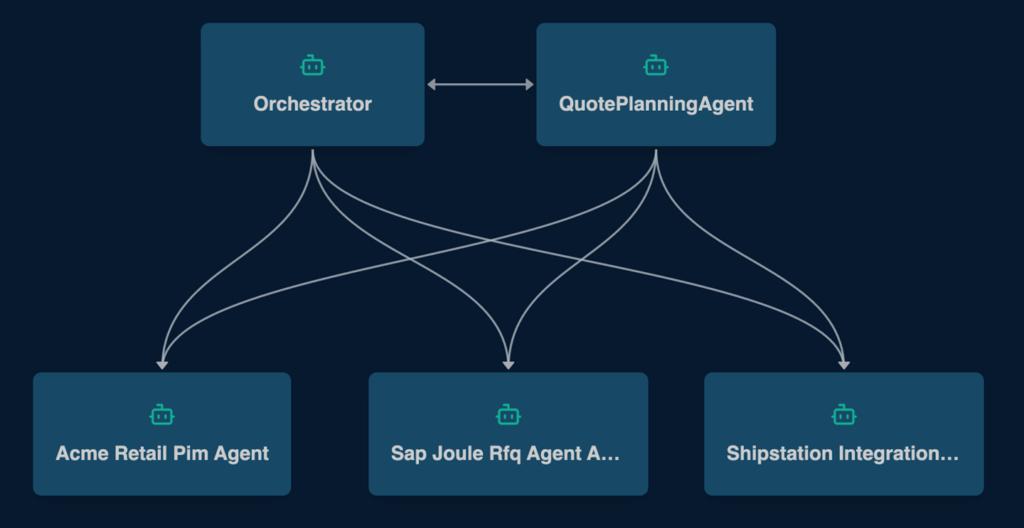
Your RFQ agent needs to coordinate across multiple platforms:
- Query the Salesforce-based customer service agent for customer history and preferences
- Query the RAG agent for getting product information, up/cross selling opportunities
- Call the SAP Business Agent Foundation(prototype) agent for ATP, pricing and sourcing options
- Trigger the logistics agent (third-party) for shipping calculation
- Update the CRM agent with the final quote
Without unified orchestration, you would have to build a pair of point-to-point integrations (one in each direction!) between each set of platforms, and .the complexity explodes per the famous equation N x N+1 / 2: 5 platforms need 20 integrations, 10 platforms need 90, each with its own auth, error handling, retries, and monitoring.
How Solace Agent Mesh Addresses the Multi-Platform Challenge
Agent Mesh was designed specifically for this heterogeneous reality. Here’s how it solves the RFQ automation scenario and enables cross-platform agent coordination:
Event-Driven Agent Coordination Across Platforms
The Problem: Your RFQ arrives via email. Without Agent Mesh, you’d build separate integrations to trigger agents on Salesforce, AWS, Azure, and SAP BTP, each with different authentication mechanisms and trigger patterns.
How Agent Mesh Solves It:
- An RFQ email triggers a workflow via SAP BTP Advanced Event Mesh.
- The orchestrator builds an execution plan, invokes the required agents, collates their responses, and returns a complete quote.
The Result: One event, multiple interactions across platforms and no custom integration code required. When the customer service agent updates the customer context, it publishes back to the main orchestrator, making that data immediately available to all other agents in the workflow.
Unified State Management Across Agent Platforms
The Problem: Your workflow spans 15-20 minutes across multiple agents: Salesforce responds in 20 seconds, PIM in 30 seconds, SAP in 4 minutes (querying warehouses), and shipping in 1 minute. Sequential execution plus wait states adds up.
How Solace Agent Mesh Solves It:
- Workflow state persists in SAM’s orchestration engine, not in individual agent frameworks
- If the SAP agent takes 10 minutes, Agent Mesh maintains context and resumes exactly where it left off
- Agents remain stateless; Agent Mesh manages the correlation between RFQ ID, customer context, inventory results, pricing calculations, etc.
The Result: A single workflow spanning Salesforce, SAP and custom agents maintain perfect state consistency without requiring any agent platform to handle long-running state.
Protocol Translation for Heterogeneous Agent Communication
The Problem: Your Salesforce and RAG agents use A2A; SAP and shipping use REST APIs. You’d normally build protocol adapters for each.
How Agent Mesh Solves It:
- Proxy agents handle translation automatically. A2A agents connect via A2A proxy, REST agents via REST proxy.
- Agent Mesh converts everything to events internally; you write zero adapter code.
The Result: Zero custom protocol adapters. Each agent uses its native communication pattern; Agent Mesh handles all translations.
Unified Governance and Audit Trail
The Problem: Your RFQ agent made a decision: “Offer 12% discount, commit to May 15 delivery from Munich warehouse, total quote €47,350.” That decision involved 3 different agents across 4 platforms. When your auditor asks, “Why this decision?”, you have partial logs in Salesforce, SAP, and your custom agents – but no unified view.
How Agent Mesh Solves It:
- Every agent invocation, decision, and data exchange flow through Agent Mesh’s underlying Advanced Event Mesh Broker
- Agent Mesh’s governance layer captures which user triggered the workflow, which agents ran (with inputs and sequence), and each LLM’s reasoning chain
- Final decision with full lineage: “12% discount approved because customer is Tier 1 (Salesforce), margin allows 15% (SAP pricing agent), historical win rate 78% at this discount level (analytics agent)”
- Complete audit trail is accessible from Agent Mesh’s observability dashboard AND written to SAP Application Log (for SAP-centric teams)
The Result: One source of truth for compliance, debugging, and process optimization, regardless of which platform hosted by which agent.
Future-Proof Agent Platform Flexibility
The Problem: You use LangChain today. Next year you want to try n8n. When SAP releases its own framework, you’ll want that too. Normally, each switch means rewriting integration.
How Agent Mesh Solves It:
- Agents interact with Agent Mesh via standard protocols, their Agent Mesh provided proxies and the A2A (Agent-to-Agent) specification
- Switching from LangChain to n8n means updating the agent implementation, not the integration layer
- Agent Mesh’s Agent Registry allows gradual migration: run LangChain agents alongside n8n agents, both participating in the same workflows
- When SAP releases a new agentic framework, you add SAP agents to the mesh without touching existing other agents
The Result: Avoid vendor lock-in and framework churn. Your integration investment in Agent Mesh remains constant even as agent frameworks evolve.
Key Takeaways
Your SAP landscape spans multiple platforms, and your AI agents will too. What matters isn’t how great your Salesforce, AWS, and SAP agents are; it’s how well they work together.
Without Agent Mesh, enterprises face what is called the “Integration Tax”:
- 80% of agentic AI project effort goes to integration, not intelligence
- Exponential complexity as you add platforms: 5 platforms = 20 integrations, 10 platforms = 90 integrations
- Brittle point-to-point connections that break when any platform updates
- No unified governance: audit trails scattered across CloudWatch, Azure Monitor, SAP logs
- Lost business context at every platform boundary: customer sales area, pricing group, plant assignment evaporates when moving from AWS to SAP
Solace Agent Mesh provides the real-time context and orchestration layer that SAP enterprises need: native SAP connectivity, multi-platform coordination, transactional integrity, and enterprise governance. It’s built for the reality you’re operating in today –not the simplified demo scenarios that generic frameworks assume.
For SAP customers, Solace Agent Mesh isn’t another tool. It’s what gets agentic AI from pilot to production.
Appendix and links
- Solace Agent Mesh: https://solace.com/products/agent-mesh/
- Introduction to SAP Business Agent Foundation: https://community.sap.com/t5/technology-blog-posts-by-sap/ai-business-agents-and-the-evolution-of-business-automation-join-the/ba-p/13614232
Next Steps
- Star the Solace Agent Mesh Github Repository
- Try out the open-source Solace Agent Mesh: Open-source Solace Agent Mesh
- Contact us to schedule a demo: Schedule a Solace Agent Mesh Demo
- Ask to run a Solace Agent Mesh pilot : Run a pilot
Explore other posts from category: Artificial Intelligence




Subscribe to Our Blog
Get the latest trends, solutions, and insights into the event-driven future every week.