
Most enterprises are building AI agents.
Few are able to run them in production at scale.
The “Production Gap” in Agentic AI
The gap between building agents and running them is where most agentic AI initiatives stall out these days. Gartner forecasts that more than 40% of agentic AI projects will be canceled by end of 2027. MIT research found that 95% of generative AI pilots have produced no measurable return on an estimated $30-40 billion in spend. The diagnosis was not that the models are failing. It was that organizations lack the integration, feedback discipline, and operational structure to move agents into production.
Building an agent that works in a notebook is a solved problem. Building one that works reliably in production, connected to real enterprise systems, coordinated with other agents, governed, observable, continuously improving, and providing business value is a different discipline entirely; one that has come to be called the agent development lifecycle, or ADLC.
Managing Agent Lifecycles with Solace Agent Mesh
Solace Agent Mesh is a complete platform for building, testing, deploying, and operating AI agents in production. It covers the full ADLC across six stages: hiring an agent by defining its role, onboarding it to enterprise systems and data, coaching it through structured evaluation, supervising it with appropriate human oversight, enabling teamwork through multi-agent coordination, and continuously improving its performance over time. Agent Mesh includes the operational infrastructure that makes all six stages work in real enterprise environments.
Agent Mesh is more than an agentic AI framework. The distinction matters because agents require a platform for orchestrating them within workflows, governing how they participate, routing events between them, and managing them across the full ADLC. Those agents can be built on LangGraph, AWS Bedrock, custom code, or Agent Mesh’s own primitives.
Agent Mesh is built on event-driven architecture so it can handle both deterministic workflows and dynamic orchestration. That means it supports structured, repeatable processes as well as agents that reason and adapt at runtime. Agents communicate asynchronously through a real-time data distribution layer rather than synchronous API calls, which makes the system inherently more resilient, scalable, and capable of operating across clouds, data centers, and edge environments simultaneously.
It is also deliberately open. Agent Mesh supports the Model Context Protocol (MCP) and Agent2Agent (A2A), works with any large language model (LLM), and runs on any cloud. That openness reflects a conviction that enterprises will build agents using many different tools and frameworks, and that the platform connecting them should never become a lock-in risk. It is also an acknowledgement that enterprises will use agents from multiple vendors and built with multiple technologies and that enterprises expect them to work together. That is where LangGraph comes into the picture
Beyond LangGraph’s Workflow Frameworks
LangGraph is LangChain’s graph-based agent framework. It lets teams define agent workflows as explicit graphs, where nodes represent agents or processing steps and edges define the flow between them. It handles state management within the workflow, supports deterministic sequences, and gives developers precise control over how a reasoning process unfolds step by step.
For teams building tightly -controlled reasoning workflows within a single process, it works well. But getting these capabilities right is the starting point, not the finish line. Production enterprise systems demand a platform that also delivers:
- Discoverability in a Distributed Environment: Agent Mesh manages agents as independent participants in a distributed mesh, where they can be discovered at runtime and coordinate through a shared messaging fabric. It also offers deterministic workflows, quite like LangGraph, which can be sequenced through DAG-based graph relationships.
- Enterprise Reach: Agent Mesh agents can be triggered by a wide range of inputs generated by your enterprise: API calls, webhooks, emails, user interactions through web or Slack interfaces, messages from operational systems, and real-time events like transactions, alerts, and sensor readings. Agent Mesh provides a built-in entrypoint framework that handles all these input types, with authentication, authorization, and session management built in as a common layer across all of them. LangGraph agents can be wired to any of these inputs as well (usually via third-party plug-ins), but the security layer, and the governance must be built and maintained by the team. With Agent Mesh, that infrastructure is part of the platform and LangGraph agents can enjoy the benefits too.
- Lifecycle Management: Building an agent –with LangGraph or any other tool –is one step. Managing it from definition through production and continuous improvement is the harder problem. Agent Mesh operationalizes the full ADLC), i.e. defining an agent’s role and guardrails, onboarding it to enterprise systems, evaluating it before and after deployment, supervising it with calibrated human oversight, coordinating it with other agents, and improving its performance through observability and feedback.
The Need for Real-Time Data in Production
When microservices first emerged, teams connected them with synchronous REST calls between services. It worked in development, but in production, at scale, the tightly coupled nature of those connections became a liability. Slow services became bottlenecks. Restarts cascaded into failures across the system.
The industry learned over time that distributed systems need to be asynchronous and decoupled to be resilient and scalable, which is why event-driven architecture became the standard for production microservices.
Agentic AI is following the same path. Agents that work beautifully in test environments, chained together with synchronous calls, hit the same wall in production that microservices did. One slow LLM call blocks the next agent in the chain. One process restart loses everything in flight. One new agent requires changes to every component that needs to talk to it. These are not edge cases. They are the predictable consequences of building distributed systems without an asynchronous communication layer.
Agent Mesh is built with this reality as a first principle, not an afterthought. Agents communicate through a persistent messaging layer rather than direct function calls. Tasks survive process restarts because they are persisted in the broker, not held in memory. Agents run in parallel rather than sequentially, which means a slow or unavailable agent does not block the rest of the system. And because agents communicate through a shared event fabric rather than point-to-point connections, the system scales without rearchitecting every time a new agent is added.
This is also what makes Agent Mesh capable of connecting to the rest of the enterprise in real time. Real business systems, including transaction platforms, IoT sensors, CRM systems, and operational alerts, already communicate through events. An agentic AI framework that speaks the same language as those systems does not need a custom integration layer to connect to them. Agent Mesh participates in the event mesh natively, which is why it can respond to real business events in real time rather than waiting to be invoked by code.
How Agent Mesh and LangChain Work Together
One of Agent Mesh’s core design principles is that enterprises should never be forced to standardize on a single agent framework. The reality of enterprise AI deployment is that different teams, partners, and vendors will build agents using different tools, and the platform connecting them should never become a lock-in risk.
Since Agent Mesh supports MCP and A2A, agents built on other frameworks can participate in the agent mesh without requiring changes to how they were built.
Some enterprises will already have LangGraph agents in pockets of their environment. For those teams looking to move toward a production-grade agentic platform without throwing away that initial work, Agent Mesh provides two integration paths that enable existing LangGraph agents to participate in the mesh while the broader architecture matures.
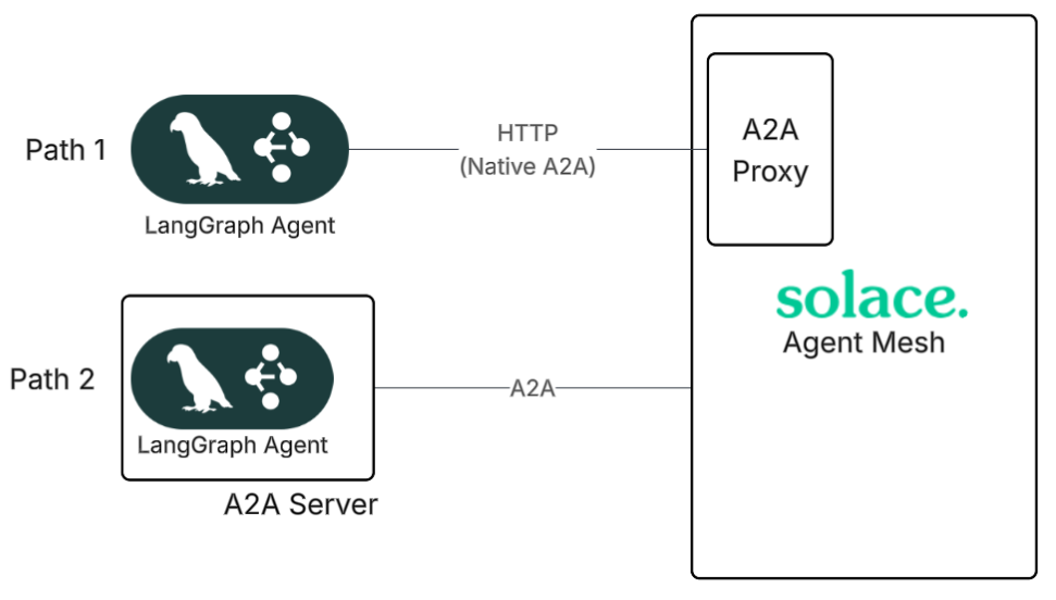
Path 1: A2A Proxy with LangGraph Agent
LangGraph agents can be exposed as A2A-compliant endpoints in several ways: via a hosted deployment to LangSmith, a package built with LangGraph Build, or a self-hosted graph wrapped behind a FastAPI interface. Once that endpoint exists, point the Agent Mesh A2A proxy at it. The proxy registers the agent with the mesh, and Agent Mesh routes tasks to it like any other agent. The graph itself stays untouched.
The trade-off is that the agent is reachable through Agent Mesh but sits behind an HTTP bridge rather than running as a native event-driven participant. For agents you do not own or cannot redeploy, this is usually the best you can do, and it works well.
Path 2: Deploy the agent with a Solace-native A2A wrapper
The cleaner approach is to give the LangGraph agent its own A2A interface, so it joins Solace Agent Mesh the same way any native Agent Mesh agent does. Solace built and maintains the LangGraph A2A Executor for exactly this purpose. It is a lightweight runtime that wraps your existing LangGraph agent without modifying the graph itself and runs it as a native A2A participant on the mesh.
https://github.com/SolaceLabs/solace-agent-mesh-langgraph-exec?tab=readme-ov-file#readme
Once running, the LangGraph agent participates on the mesh natively over A2A, with agent card discovery and conversation continuity handled by the executor. The current release focuses on getting LangGraph agents into the mesh as first-class A2A participants. Deeper integration with SAM’s broader platform services, including durable queueing, richer authentication, and multi-modal content support, continues to evolve.
Value When Expanding Your Agent Ecosystem
As the agent economy matures, enterprises will increasingly consume agent capabilities from partners and vendors who made their own framework choices:
- Your logistics partner built their shipment tracking agent on LangGraph
- Your financial data provider’s risk assessment agent runs on AWS Bedrock
- Your ERP vendor shipped a procurement agent on their own proprietary stack
SAM connects all of them through the same event fabric, governs how they participate in your workflows, and maintains the observability and reliability your production environment requires.
Conclusion: The Framework Is the Starting Point, Not the Finish Line
Many organizations already have LangChain or LangGraph agents in their environment. Agent Mesh does not ask you to start over – it runs those agents within a production-grade platform that solves for the things the frameworks leave to you: deployment across distributed environments, runtime discoverability, enterprise governance, and full lifecycle management. Any of your LangGraph investment works harder inside Agent Mesh.
If you are starting fresh, you now understand the scope of your choices. LangGraph coordinates agents within a graph the developer defines in advance, with structural relationships set at design time. Agent Mesh is built for the realities that come after: agents connected to live enterprise systems, triggered by real business inputs, governed via enterprise security controls and session management, a distributed environment, and management through every stage of their lifecycle from definition through continuous improvement.
For organizations serious about putting AI agents into production at enterprise scale, the question is not which workflow framework to start with. It is which platform will help you get the most out of every agent you build or bring in.
I hope I’ve made the case that that’s Agent Mesh.
Explore other posts from categories: Artificial Intelligence | Solace Agent Mesh




Subscribe to Our Blog
Get the latest trends, solutions, and insights into the event-driven future every week.