
Fueling the Future of Logistics with Real-Time Data and AI
Bison has modernized how information flows across its business so teams can respond faster, make better decisions, and support evolving customer demands.




At a glance:
Bison has ambitious growth plans across its freight brokerage and logistics operations. As the company expanded and customer expectations evolved, real-time access to accurate operational data became critical to maintaining service quality, improving decision-making, and supporting new digital initiatives.
While Bison has long been successful with a traditional, asset-focused operating model, the company recognized there was a limit to what its aging technology stack could support as it planned for its next growth phase.

“There’s only so far you can go with technology that supports your
current operation but may not necessarily support your growth.”
– Hal Hallsson, Enterprise Architect, Bison Transport
However, Bison’s technology landscape was built around an aging transportation management system (TMS) and tightly coupled integration patterns that were never designed for the speed and scale required today. To support its next phase of growth, Bison set out to modernize how data moves across the enterprise establishing a flexible integration foundation that could support a multi-year TMS transition while enabling real-time data flow without disruption to the business.
Challenge
Modernizing data flow without disrupting operations
As Bison’s logistics and freight brokerage business grew, the company faced increasing pressure to deliver faster insights, improve operational visibility, and support new digital initiatives. However, its existing technology landscape was not designed for this level of scale or speed.
Key challenges included:
- Tightly coupled legacy integrations: New integrations required significant effort and often resulted in one-off connections that increased complexity.
- Limited visibility and delayed insights: Critical operational data was often siloed or delayed due to batch-based and point-to-point integration patterns.
- TMS modernization in progress: Legacy and modern systems needed to remain synchronized during a multi-year TMS transition without disrupting daily operations.
- Need for both real-time and API-driven integration: Traditional APIs remained essential, but the business increasingly required real-time data across domains such as orders, equipment, and logistics operations.
For Bison, the biggest challenge wasn’t simply moving data, it was managing the velocity of data between legacy and modern systems while keeping operations running. The legacy approach relied heavily on direct database calls, creating performance bottlenecks that could not scale with future growth. Attempting to synchronize old and new systems without a new architectural model would have pushed infrastructure beyond its limits.
Event-driven architecture (EDA) emerged as the way to moderate different speeds of data movement enabling high-velocity event streams while maintaining stability across systems.
Selection
Evaluating the Right Modernization Approach
Choosing a strategy before choosing technology
Modernizing a core integration foundation required a thoughtful and low-risk approach. Bison recognized early that no single technology could meet every integration need across APIs, data pipelines, and real-time event streaming. Instead, the team focused on defining the architectural principles that would guide the transformation.
When Hal joined Bison, one of his first priorities was establishing an architecture practice to guide modernization decisions. The team quickly saw how tightly coupled the legacy environment had become; changing one part pulled on many others.
Bison’s priorities:
- Decouple legacy systems to reduce technical debt
- Support hybrid deployments across on-premises and cloud
- Enable real-time and traditional integration patterns to coexist
- Avoid creating a new generation of tightly coupled integrations
- Support a phased TMS migration without business disruption
The goal was to introduce a modern platform over time while keeping day-to-day operations stable effectively building a bridge from the legacy world to the new one with care.
Engaging Solace early to shape the architecture
To accelerate progress and reduce risk, Bison engaged Solace early in the journey. Working closely with Bison’s architecture and integration teams, Solace helped:
- Evaluate technology options
- Define the target integration architecture
- Identify an initial use case to prove the approach quickly
- Establish a roadmap for scalable adoption
Beyond technology selection, the engagement helped build internal confidence. Proof-of-concept initiatives demonstrated that the architecture could handle high-velocity workloads and move from pilot to production quickly without disrupting operations.
Bison ultimately adopted a composable, best-of-breed approach, selecting technologies that could work together seamlessly across API management, event streaming, and data integration layers.
Solution
A Real-Time Data Backbone for Modernization
With a clear strategy in place, Bison implemented a modern integration foundation with Solace Platform serving as the backbone for real-time data movement across the enterprise.
Instead of continuing to build point-to-point integrations, Bison established a reusable real-time data layer that allows systems, applications, and analytics platforms to exchange information continuously across on-premises and cloud environments. This includes a master data approach, where Solace helps ensure clean, consistent data is shared across systems in near real-time.
Solace’s performance and capacity were key to supporting the complexity and scale of Bison’s transportation ecosystem. The platform enables high-throughput event processing while synchronizing legacy and modern systems during the transition.
This foundation enables:
- Real-time data flow across business domains
- Decoupling of legacy and modern systems
- Hybrid integration across on-premises and cloud environments
- A reusable model for onboarding new systems and use cases
By centralizing real-time event distribution, Bison reduced integration friction and positioned itself for long-term scalability.
Connecting APIs, data pipelines, and analytics
With Solace at the center, Bison can connect APIs, applications, and data pipelines through a shared real-time event layer. This ensures operational systems and analytics platforms receive fresh data continuously while avoiding new integration silos. Solace also plays a critical role in synchronizing old and new systems during the transition.
A reusable model for growth
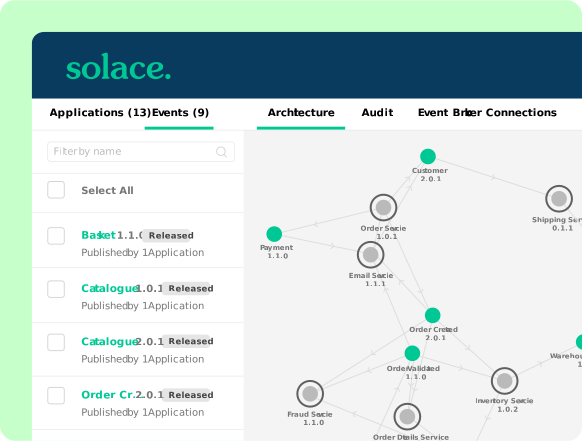
To accelerate implementation and create a repeatable pattern, Bison leveraged Solace micro-integrations to orchestrate multi-step workflows and document architecture and integration flows in Solace Hub for reuse as new domains are onboarded.
Outcome
Faster decisions and simpler operations
With its new real-time data foundation in place, Bison has modernized how information flows across the business. The company now has operational, transactional, and analytical data at the velocity needed for growth, significantly reducing the delay between activity and insight. Teams can respond faster, make better decisions, and support evolving customer demands.
The investment has also dramatically improved speed to deployment. Initiatives that previously could take up to a year to deliver can now be introduced in a fraction of that time.
The architecture has reduced integration complexity, simplified workflows in parts of the business, and created a scalable foundation that supports continued growth and TMS modernization.
As the technology landscape continues to evolve, Bison now has a more consistent and governed way to share information across systems, providing greater visibility, stronger control, and a scalable foundation for continued growth.
Key business outcomes include:
- Faster access to accurate, up-to-date operational and analytics insights
- Reduced effort and risk when introducing new systems and capabilities
- A scalable data foundation that supports continued growth and TMS modernization
“Improved delivery velocity and reliability allow our teams to introduce new functionality faster, and frees up capacity to advance other operational initiatives.”
What's Next
Preparing for the next era of intelligent operations
With a modern, real-time data foundation now in place, Bison is turning its focus to what this enables next.
As more systems begin to publish and consume real-time events, the company is building a richer, more connected view of its operations, opening the door to new levels of automation and intelligence. Instead of reacting to changes after the fact, Bison is moving toward a future where systems can anticipate, recommend, and act on operational conditions as they happen.
Bison sees data velocity, availability and accuracy as prerequisites for AI-driven innovation.
Bison is taking an incremental approach to transformation, layering intelligent automation onto its existing architecture. Built on event driven data and observability, this foundation enables the adoption of agentic AI to improve logistics performance, increase responsiveness, and support faster, more informed decision making.
What began as an integration modernization effort is now evolving into a strategic platform for innovation positioning Bison to continue transforming how it operates and grows in the years ahead.
“Data velocity, data availability and data accuracy are the precursors for implementing anything AI in the future.”
Ready to Take the Next Step?
If you’re itching to build your own event-driven applications, fire up a free trial of Solace Platform now. If you’re not quite there, watch a quick product tour that’ll familiarize you with what you’ll see when you do feel ready.