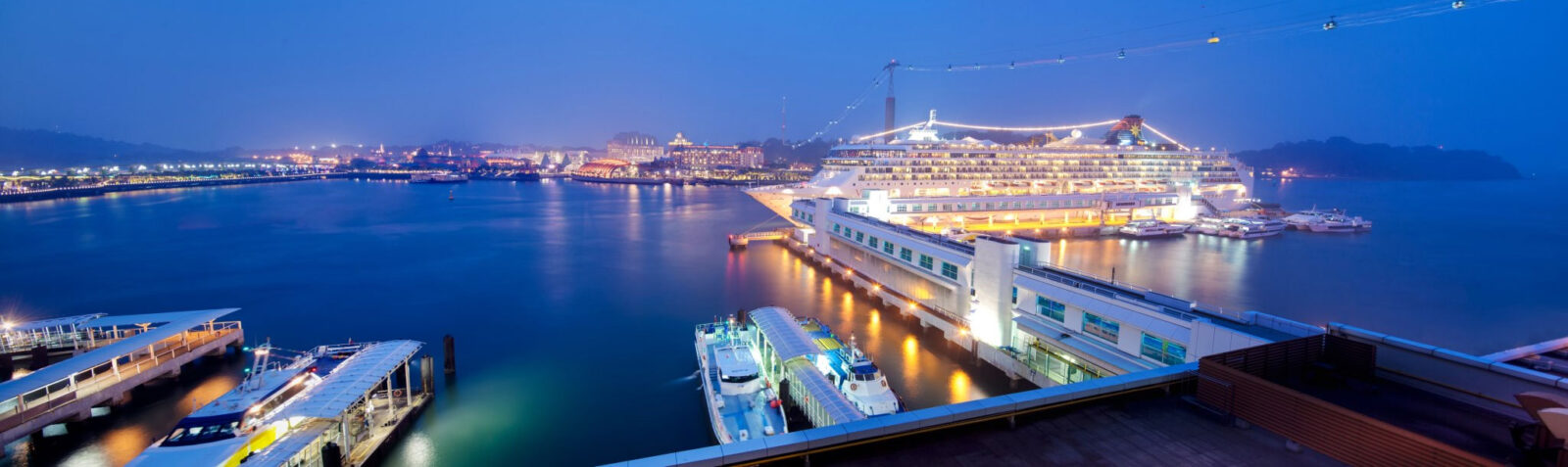
Singapore Cruise Centre is nearing the final phase of a five-year digital transformation designed to modernize terminal operations while delivering end-to-end passenger experiences. Central to this transformation is a real-time data platform built using Solace Platform, which enables Singapore Cruise Centre to orchestrate passengers, vessels, baggage, resources, and ecosystem partner systems in real-time.
Beyond improving passenger journeys, this approach strengthens operational effectiveness, situational awareness, and coordination across the wider maritime ecosystem—while preparing Singapore Cruise Centre for an AI-driven future.
Challenge
Maritime passenger operations are inherently complex. Passenger journeys, vessel movements, baggage handling, staffing, and shared resources were historically managed across siloed systems, batch integrations, and manual processes. This fragmentation made it difficult to respond quickly to operational variability such as delayed vessels, passenger surges, or last-minute staffing changes.
As passenger expectations increased and operational constraints tightened—including manpower costs, limited berth capacity, and rising complexity—Singapore Cruise Centre needed a way to operate with airport-like precision and responsiveness.
Solution
Singapore Cruise Centre adopted a real-time data integration platform powered by Solace Platform as the backbone of its digital transformation. Operational data now flows continuously across internal systems and ecosystem partners via an event mesh. When an event occurs—such as a booking confirmation, departure update, or sensor-triggered vessel movement—it is published once and immediately consumed by all relevant applications.
This unified data layer (aka event mesh) enables live orchestration across passengers, vessels, baggage, staff, and shared resources. Singapore Cruise Centre structures operations around a four-stage, event-driven data lifecycle that connects planning systems, operational platforms, sensors, and frontline teams through continuous real-time data:
- Seasonal: Historical voyage data, projected passenger volumes, and advance schedules stream into planning systems to forecast berth utilization, capacity, and long-term resource needs.
- Pre-Tactical: As bookings firm up, confirmed itineraries, passenger manifests, and operator schedules are shared in real-time to refine staffing, equipment readiness, and terminal allocations.
- Tactical: Live events from check-in systems, immigration gates, vessel sensors, CCTV analytics, and frontline applications continuously update passenger flow, queue length, equipment status, and vessel movements—allowing teams to dynamically rebalance staff, gates, berths, and shared resources.
- Post-Tactical: Operational events are retained as an audit trail to automate reconciliation, assess performance, and improve future sailings.
Real-time events also power everyday systems such as Public Announcements. Instead of polling backend systems, operational changes are instantly published and subscribed to across terminals, keeping passenger communications aligned with live conditions while reducing manual intervention.
Together, these capabilities have transformed siloed terminal infrastructure into a responsive operational ecosystem—optimizing every movement from long-term planning to final departure.
Benefits
By shifting from batch integrations to real-time, event-driven operations, Singapore Cruise Centre has improved passenger throughput, strengthened operational resilience, and connected terminals with ecosystem partners.
Passenger check-in events now flow directly to immigration systems for biometric, document-free clearance in under five seconds, while live operational signals enable teams to rebalance staff, berths, and shared resources as conditions change—supporting rapid vessel turnaround, including optimizing 300-seat ferry departures within 30 minutes. The same real-time foundation extends across air, land, and sea through standardized data sharing with ferry operators, government agencies, and transport partners, improving transfer reliability, reducing handoff errors, and strengthening passenger security.
Key outcomes include:
- Operational resilience: Real-time visibility across terminals, vessels, passengers, baggage, and shared resources enables faster response to disruption
- Passenger experience: Biometric, document-free immigration clearance in seconds and clearer real-time communications
- Productivity gains: Reduced manual coordination through automated, event-driven workflows
- Asset utilization: Dynamic berth and resource allocation improves ferry and cruise turnaround performance
- Ecosystem connectivity: Live data exchange with operators and government agencies across air, land, and sea
- Future readiness: Foundation for a Maritime Passenger Terminal Digital Twin and AI-driven operations
AI-Ready Operations
This real-time integration layer also supports Singapore Cruise Centre’s transition toward AI-enabled operations. As the organization advances toward an integrated operations center, Solace’s real-time data and agentic AI platform lets AI services to act directly on live operational data:
- Internal Gen AI — Faster access to operational knowledge from policies, SOPs, checklists, and data lakes to support frontline execution
- Analytics with AI — Predictive and prescriptive insights that surface risks early and recommend pre-emptive actions
- Digital Twin with Agentic AI — Unified IT/OT visibility that enables AI-augmented decisions, automated workflows, reporting, and coordinated responses across terminals, vessels, and partners
With this foundation in place, Singapore Cruise Centre is progressing from retrospective reporting to proactive operational intelligence—setting a new benchmark for smarter, safer maritime passenger operations.
Looking Ahead
As Singapore Cruise Centre enters the final stretch of its transformation, one lesson stands out: digitalization is not about deploying more systems—it’s about connecting them intelligently. With real-time data and agentic AI enabled by Solace, Singapore Cruise Centre has turned operational complexity into clarity and infrastructure into an adaptive platform—creating the foundation for the next generation of resilient, passenger-centric maritime terminals.
Learn More
As part of EDA Summit 2024, Singapore Cruise Centre’s VP of Technology & IT Lee Siew Kit shared insights into their goals, journey and lessons they learned.
