
Agentic AI is having a moment, and for good reason — AI agents that can perceive their environment, reason autonomously, use tools, and collaborate with each other represent a giant leap beyond the chatbots and automation scripts that came before.
Unfortunately, most organizations don’t yet know how to effectively deploy those agents, manage their performance, and get them working together. They’re spinning up agents, giving them access to a bunch of systems, and hoping for the best. Some companies manage their people like that, and if you’ve had the misfortune of working for one, you know how frustrating and ineffective it can be. Which leads me to the premise of learning lessons from HR to improve the effectiveness of agentic AI initiatives.
The Key to Making Your Agents Effective
Think about what makes an AI agent tick, and what they need to do their job. They have:
- A brain (a large language model, or LLM) capable of reasoning and planning
- Specialized skills tailored to a domain
- Tools that let them take action — searching, writing, calling APIs or MCP servers, etc.
- Access to the information they need to do their job.
First, note that people you hire have the same things. Then consider the fact that even the best and brightest people that you hire don’t show up on day one ready to operate autonomously across every corner of your business, and you don’t just let them do their thing forever without checking in on them. They go through a very deliberate process, i.e. they are:
- Onboarded into systems and workflows
- Trained on company-specific knowledge
- Supervised as they build trust; then evaluated and developed over time
- Integrated into high-performing teams
AI agents need those same things!
What Happens When You Skip the Process
Picture an organization where every employee is a generalist, there’s no hierarchy or structure, and all communication happens via synchronous one-to-one phone calls. No email. No Slack. No shared systems. That organization can’t scale. Information doesn’t flow. People drown in data from every direction, with no real understanding of what’s going on or what to do. There are no accountability structures, no access controls, no coordination mechanisms beyond individual conversations.
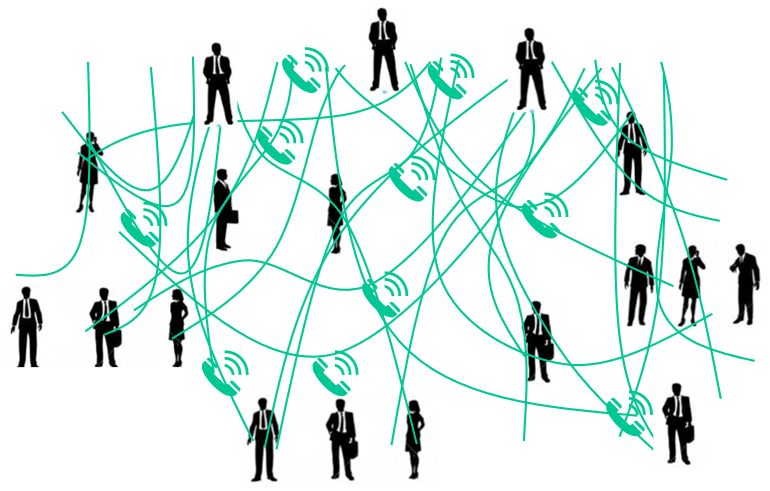
This is how most early agentic AI deployments work: complex monolithic agents tasked with doing everything, accessing all data, communicating synchronously, and trying to maintain very large context or working synchronously with sub-agents. The result? A system that’s brittle, expensive, inconsistent, and completely unable to handle real enterprise complexity.
The Better Model: Specialists, Hierarchy, and Asynchronous Communication
Effective organizations look different – people are specialized, and organized hierarchically, so coordination happens in parallel, and they communicate primarily through asynchronous channels that let information flow without requiring everyone to be online at the same time. They implement focused context and role-based access to systems, so people see only what they need.
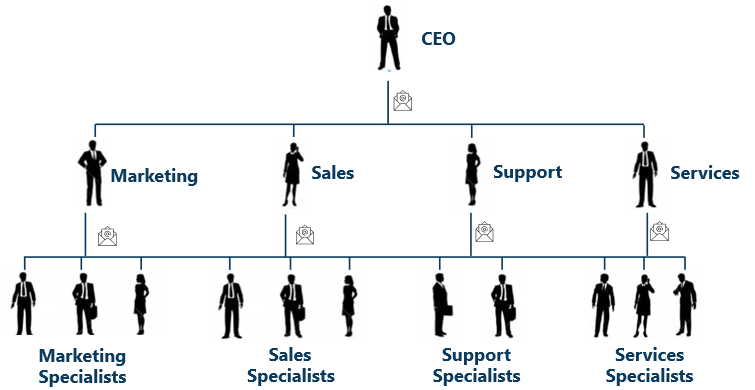
Solace Agent Mesh, Solace’s agent development and runtime platform, applies these same concepts to agentic AI. Agent Mesh helps you build agentic applications that actually work for your enterprise: business users build agents with no code while developers code sophisticated ones. They’re all deployed and managed via one interface, fed real-time data through pre-built connectors, and governed by the role-based access controls we’re known for, with a visual interface for monitoring agent activity in real time.
With Agent Mesh, agents are specialized for particular functions, organized hierarchically, and their actions are orchestrated by agents that specialize in delegating tasks to appropriate agents. Communication between agents is asynchronous and event-driven — built on Solace’s proven real-time data infrastructure – and access to data and systems is governed by role-based access controls, giving agents exactly the permissions they need and nothing more.
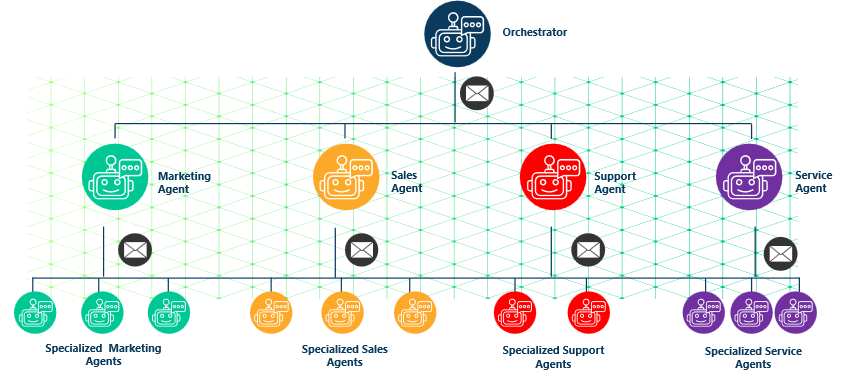
How Solace Agent Mesh Lets You Treat Your Agents Like Employees
This kind of structured, lifecycle-based thinking has a name in the agentic AI world: the agent development lifecycle, or ADLC. Just as the software development lifecycle (SDLC) brought repeatable discipline to how applications get built, shipped, and maintained, the ADLC brings that same discipline to how AI agents are hired, onboarded, trained, supervised, organized into teams, and continuously improved. It’s how the industry is starting to formalize what good organizations have always done with their people — applied to the new workforce of software-based agents. We need a new kind of development lifecycle rather than the traditional SDLC because agents are different than traditional software – so they require specialized consideration. (For a deeper look at the framework itself, see our paper Managing AI Agents at Scale: The Agent Development Lifecycle.)
Solace Agent Mesh organizes the full journey of an AI agent into six lifecycle stages and supports those who develop agents with capabilities at each stage of the lifecycle — each reflective of a phase of the human employee experience, and mapped to the ADLC, seen here:
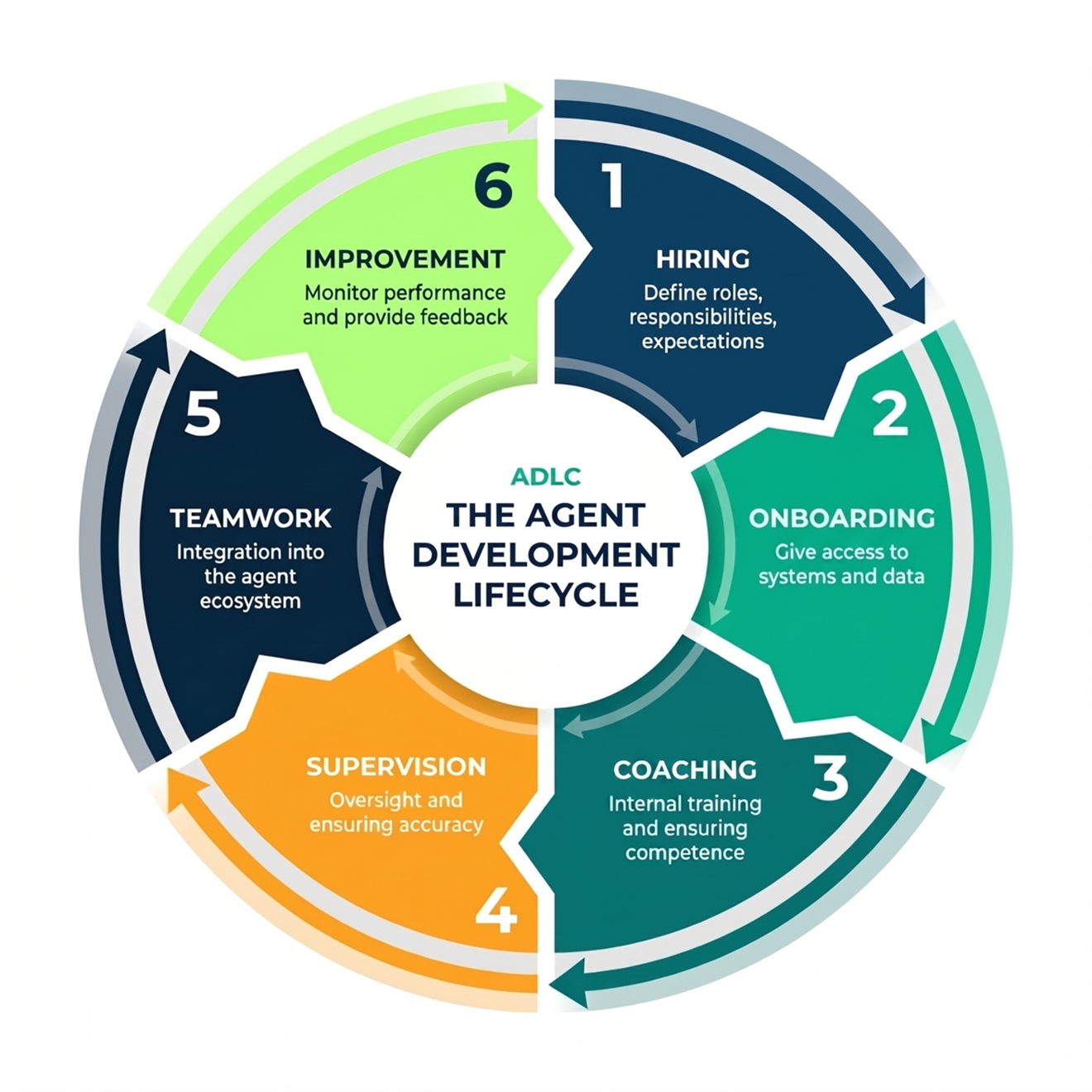
1. Hiring: Define Role, Responsibilities, Expectations
Before a human employee starts, you write the job description. You define what role they’ll fill, what they’re responsible for, what behaviors you expect, and what boundaries they operate within.
Agent Mesh’s agent builder uses an internal AI agent to provide a guided interface for defining an agent’s purpose, scope, and configuration. You set up the instructions and system prompts that shape the agent’s persona and behavioral parameters. And you configure guardrails — hard constraints on what the agent can and cannot do — that prevent it from going off-script or taking unsafe actions. Alternatively, you can take a pro-code/pro-config approach to building agents in your favorite AI coding assistant aided by an Agent Mesh skill that make your coding assistant an expert at creating Agent Mesh agents.
2. Onboarding: Give Access to Systems
A new employee’s first weeks are spent getting access to tools, systems, and data. Agent onboarding is the same.
Agent Mesh includes a number of data connectors – pre-built integrations to enterprise databases, data warehouses, data lakes, enterprise application APIs, and MCP servers. They enable agents to access real-time data from day one. Access is provisioned through role-based access controls (RBAC), enforcing least-privilege principles so agents only see what they need to see. You can create your own agent tools to access your systems or create a semantic data layer or to write code to do whatever you need an agent to do using our SDK, then load it into Agent Mesh for use by the agents. You can also define Skills that go with your tools so agents know best how to use them.
3. Coaching: Internal Training to Ensure Competence
After getting access to systems, human employees undergo training. This is where general ability becomes company and job-specific skills.
Agent Mesh provides an Eval function that uses AI to suggest tests for your agents, allows you to add more and then run them against your agents. This allows you to validate agent competence against defined success criteria during development. This supports both initial testing and regression tests as you make changes. You wouldn’t put a new hire in front of customers without verifying they know what they are doing. The same logic applies here.
4. Supervision: Trust, But Verify
Even the most capable employee gets close oversight when they’re new to a role. Supervision isn’t micromanagement — it’s the safety net that ensures quality, builds trust, and catches errors before they compound.
Agent Mesh’s human-in-the-loop architecture lets you route specific agent actions or decisions to human reviewers for approval before execution. This is important in agentic systems because LLMs are non-deterministic, they make mistakes so when the impact of agents being wrong is too high humans should validate their actions, responses or conclusions. Integrated human-in-the-loop functionality is what makes it possible to deploy agents in high-stakes enterprise contexts with confidence.
5. Teamwork: Where the Real Value Emerges
The most transformative phase of the employee lifecycle is when individuals become part of high-performing teams — where collective capability exceeds the sum of its parts. For AI agents, this is where things get really interesting.
Agent Mesh supports two types of agent teamwork:
- Workflows let you define repeatable processes such as the steps involved in approving a loan or providing an insurance quote or opening an account.
- Dynamic agent orchestration lets you coordinate multiple agents in sequence or parallel, with orchestrator agents intelligently routing tasks to specialists based on context for situations where the input is more dynamic and reasoning is required to determine and execute a plan to respond to an input.
The result is a multi-agent mesh topology — hierarchical agent organizations coordinating specialist agents across various functions— that mirrors the structure of an effective human organization. And like an organization, the communication between Agent Mesh agents is asynchronous via events for better scalability, robustness and loose coupling.
6. Improvement: Deployment Is Not the Finish Line – it’s the Starting Line
Effective organizations don’t deploy employees and forget about them. They monitor performance, provide feedback, and create mechanisms for continuous improvement.
Agent Mesh’s visualizer gives you a real-time graphical interface for tracing agent interactions, tool and LLM calls, and decision pathways — so you can see exactly what your agents are doing and why. Ongoing evaluations detect performance drift or emerging failure modes via online evals that run in the background monitoring production execution. And OpenTelemetry instrumentation surfaces performance trends over time, giving you the data to make informed decisions about when and how to tune your agents.
Beyond ADLC: Other Advantages of Solace Agent Mesh
Beyond the lifecycle framework, there are a few things worth calling out about how Agent Mesh is built.
- It scales without chaos. Individual agents are straightforward. Dozens or hundreds of coordinated agents across business functions are a different beast entirely. The combination of hierarchy, specialization, dynamic agent discovery, async communication, and role-based access provides structural foundations for AI deployments that grow without falling apart.
- It builds trust through governance. Enterprise agentic AI production deployments stall not because of technical limitations but because leaders can’t be confident agents will behave predictably. Guardrails at hiring, RBAC at onboarding, human-in-the-loop supervision, and continuous monitoring and improvement are designed to build that trust incrementally.
- It avoids lock-in. Agent Mesh is LLM-agnostic, cloud-agnostic, and can work with 3rd party agents via the Agent-to-Agent protocol. You can swap models, swap hyperscalers, hot-swap agents, and integrate new tools without rearchitecting your agent If you’ve already invested in LangGraph, AWS Bedrock AgentCore, or Azure AI, Agent Mesh complements those investments rather than replacing them — providing the event backbone, orchestration layer, and enterprise scalability and reliability they lack on their own. As the capabilities and price of models changes dramatically, where you want to deploy agents (typically near your data) can vary and where you want no lockin for the future –Agent Mesh gives you this flexibility.
- Event-driven is the native architecture. Solace’s core expertise is real-time data and microservices, steeped in two decades of experience as the leading enabler of event-driven architecture — the same pattern that powers many of the world’s leading enterprises. Applying EDA to multi-agent AI isn’t a retrofit; it’s a natural extension. Agents communicating via asynchronous, decoupled events are inherently more resilient, more scalable, and better suited to the messy reality of enterprise workflows than anything built on synchronous API calls. These are the same lessons leared with traditional microservices that became event driven for all the same reasons. Agent Mesh is the only agentic AI platform that’s “event-driven” from the ground up.
The Bottom Line: Agent Mesh Makes it Easy to Implement ADLC
The parallel between human workers and AI agents isn’t just a convenient metaphor. It’s a design principle. Organizations have spent decades — centuries, really — figuring out how to hire, train, supervise, and organize human talent into high-performing teams. That institutional wisdom doesn’t become irrelevant just because the workers are made of software instead of carbon.
Solace Agent Mesh is how that wisdom gets applied to AI agents. It’s an agent development and runtime platform that lets you implement the ADLC end-to-end, at enterprise scale. The result is a platform that doesn’t just deploy agents — it manages them through their entire lifecycle, from creation to continuous improvement to full multi-agent orchestration.
If AI agents are truly your new teammates, they deserve infrastructure that makes them great ones.
To see a demo of Solace Agent Mesh, visit https://solace.com/agent-mesh-demo/
Explore other posts from categories: Artificial Intelligence | Products & Technology | Solace Agent Mesh




Subscribe to Our Blog
Get the latest trends, solutions, and insights into the event-driven future every week.