
You have built a mesh of AI agents that can reason, collaborate, and act. They analyze data, answer questions, and orchestrate complex workflows. But here is the hard question: how does anyone actually use them?
An agent that only lives inside a developer’s terminal is a demo. An agent that meets users where they already work, whether in Slack, through a REST API, on a web dashboard, or via an event stream, is a product. The gap between “impressive prototype” and “useful tool” is exactly what entrypoints solve in Solace Agent Mesh.
This post explains what entrypoints are, which ones are ready to use today, and how you can build your own.
What is an Agent Mesh Entrypoint?
In Solace Agent Mesh, entrypoints (formerly known as gateways) are external-facing interfaces that connect your agent mesh to the outside world. They sit between your users, or your systems, and the agents that do the work.
Think of it this way: your agents communicate with each other over an event mesh you build with Solace Platform (specifically Solace Event Broker) using the A2A protocol. A2A is powerful, but your end users don’t speak A2A…they speak HTTP. They speak Slack. They speak webhook payloads. An entrypoint translates between the two worlds.
Every entrypoint handles four core responsibilities:
- Protocol translation and routing: Convert external formats (e.g. HTTP requests, WebSocket messages, Slack events) into standardized A2A messages, route them to the right agent through the event mesh, and translate responses back. All communication is asynchronous and mediated by the Solace event broker.
- Authentication and identity: Verify who the user is, retrieve their permissions, and pass that context to the agents. SAM supports pluggable identity providers, so you can wire in your existing auth system.
- System purpose: Each entrypoint carries a configurable context that tells agents how to interpret requests coming through that channel. A Slack entrypoint might instruct agents to keep responses concise, while a web UI entrypoint might allow for richer formatting.
- Output control: Shape how agents format their responses for that specific channel: markdown for the web, plain text for chat, structured JSON for APIs.
This means entrypoints and agents are fully decoupled—agents don’t know (or care) whether a request came from Slack, a REST call, or an event stream; and they don’t need to know which agents exist or how they work internally, as your event mesh handles all of the routing.
This diagram shows how external systems connect through entrypoints to Solace event broker, which routes requests to agents using A2A. Solid lines represent entrypoints that are available today, and dashed lines represent extensibility points where you can build your own.
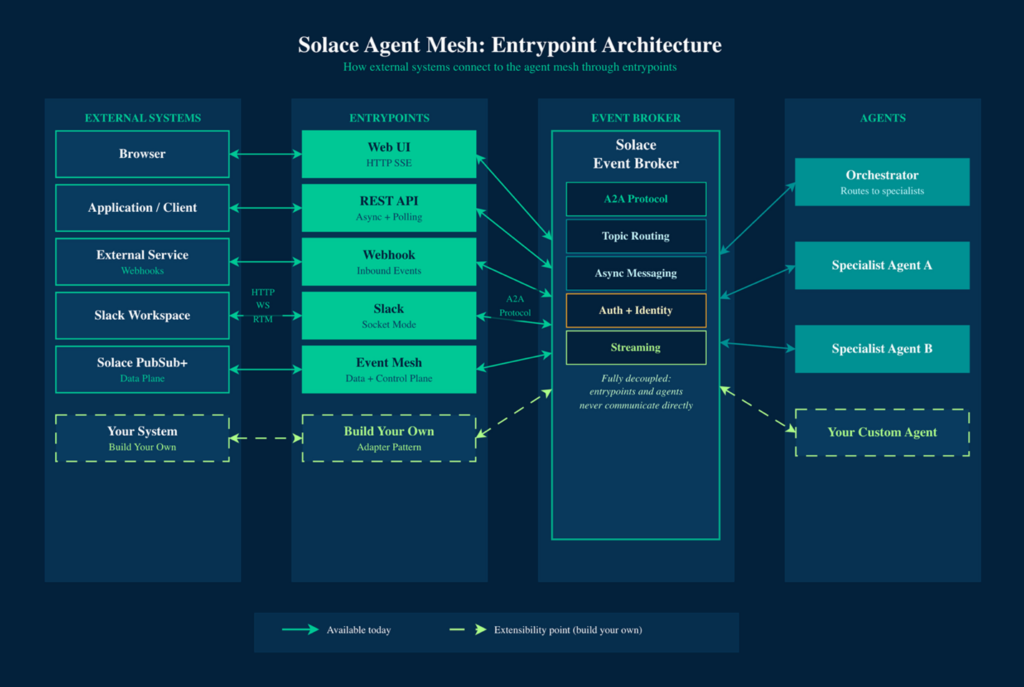
Available Entrypoints
Agent Mesh ships with a growing set of entrypoints that cover the most common access patterns. Here is what you can use right now.
Web UI (HTTP SSE)
The web interface is more than a chat window. Built on server-sent events (SSE), it delivers streaming responses as agents work, but it also handles session management, artifact storage, content rendering, activity tracking, and observability. It supports file uploads and downloads out of the box. This is the fastest way to put a full-featured interface on your agent mesh.
REST API
The REST entrypoint provides programmatic access with a clean async pattern: submit a task, get back a task ID, and poll for results. This makes it straightforward to integrate with any system that speaks HTTP. If you are building an application that needs to call your agents from backend code, this is your starting point.
Webhook
The webhook entrypoint handles incoming webhook requests and transforms their payloads into A2A messages. Use it when you want external systems to trigger your agents based on events.
Slack
The Slack entrypoint connects your agent mesh to Slack workspaces through Socket Mode. It handles messages and @mentions, with file handling support.
Event Mesh
The event mesh entrypoint is the Solace-native integration. It connects your agent mesh to your existing Solace infrastructure, allowing event streams on the data plane to trigger agent workflows on the control plane. It supports expression-based message transformation, dynamic response routing, and at-least-once delivery semantics. If you already run a Solace event mesh, this entrypoint lets your agents participate in your existing event-driven architecture.
Build Your Own Entrypoint
The entrypoints above cover the most common patterns, but every organization has unique systems and workflows. Solace Agent Mesh makes it straightforward to build custom entrypoints with a framework that handles the hard parts for you.
The Gateway Adapter Pattern
The recommended approach is the gateway adapter pattern. You write a Python class that translates between your platform and Solace Agent Mesh . The framework handles all A2A mechanics, authentication flows, and event mesh communication. You focus on what you know: your platform’s API.
Here is what you implement:
prepare_task(): Convert an incoming platform event into a SAM task (text, files, or structured data)handle_update(): Forward streaming agent updates back to your platformextract_auth_claims(): Pull user identity from the platform eventhandle_task_complete()and handle_error(): Handle completion and error scenarios
To scaffold a new entrypoint plugin, run:
sam plugin create my-gateway-plugin
Select “Gateway Plugin” when prompted. This generates a complete project structure with the adapter class, configuration templates, and packaging setup. From there, you fill in the platform-specific logic: which API to listen on, how to format responses, how to authenticate users. The framework handles everything else.
For teams that need full control over the A2A lifecycle, such as custom authentication flows, multi-stage processing pipelines, or specialized protocol behavior, Agent Mesh also supports a full custom entrypoint pattern that extends the base gateway components directly. The component structure is well-defined enough that you can even use AI coding assistants to scaffold a working entrypoint from a plain-language description.
What Agent Mesh Entrypoints Mean for Your Architecture
Entrypoints turn Solace Agent Mesh from an internal agent framework into an integration platform. Each new entrypoint you add opens your agents to an entirely new audience or system, without changing a single line of agent code.
Your Slack users get a conversational interface. Your developers get a REST API. Your event-driven systems get native Solace integration. Your ops team gets a web dashboard. And when you need something that does not exist yet, you build it with the adapter pattern in an afternoon.
The agents stay the same. The mesh stays the same. Only the entrypoints change.
Explore other posts from categories: Artificial Intelligence | Solace Agent Mesh




Subscribe to Our Blog
Get the latest trends, solutions, and insights into the event-driven future every week.