One Runtime, Many Agents: Solace Agent Mesh Rebuilt in Go
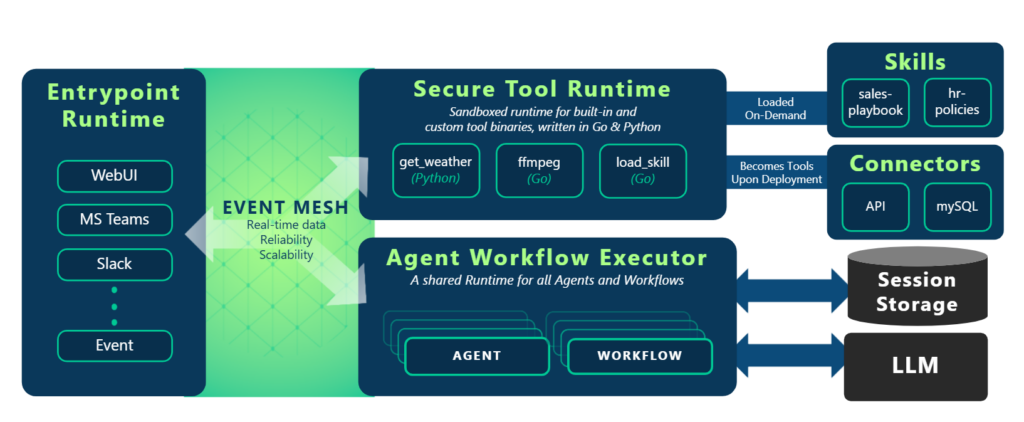
Agent Mesh has been rewritten in Go and shaped into three event-driven components. Agents are no longer deployed processes, they are configuration swapped into a shared runtime, so cost tracks processing instead of agent count.
Until now, adding an agent meant adding a deployment. Another process, another thing to monitor, another line on the infrastructure bill whether that agent fired a thousand times an hour or twice a day. At a hundred agents that arithmetic stops being a rounding error. That is no longer how Agent Mesh works.
What changed underneath
- The runtime is now Go, not Python. Smaller, faster executables with better concurrency, and a deployment footprint of one static binary on the desktop or three pods in Kubernetes.
- Three event-driven components, not one process per agent. The Entrypoint Runtime handles invocation and the security decisions that belong at the boundary, including web chat, Slack, an inbound event, an API call. The Agent Workflow Executor runs the LLM loop for every agent. The Secure Tool Runtime executes tools, each in its own sandbox.
- Agents are configuration, not code. The executor is stateless and scales in both directions; adding an agent means adding configuration, not standing up a new deployment. A single executor commonly runs dozens of agents, bound only by available CPU.
- Custom tools, safely. Write your own in Go or Python with the Tools SDK and the AI coding Skills we ship, and run them sandboxed and isolated from every other tool. This is the same mechanism that lets us run customer-authored tools in our own SaaS.
- Workflows that mix agentic and deterministic steps. Branches, loops, and scatter/gather, with an LLM on the nodes that need judgment and ordinary deterministic tooling on the ones that don’t. Describe the workflow to the Quick Build Agent in natural language and it constructs it.
- Nothing you built has to move. Same YAML configuration model, same UI concepts. The rewrite replaced what runs underneath while leaving every external surface intact.
Why the cost curve actually bends
Two lines drive cost in an agentic system, and this release moves both.
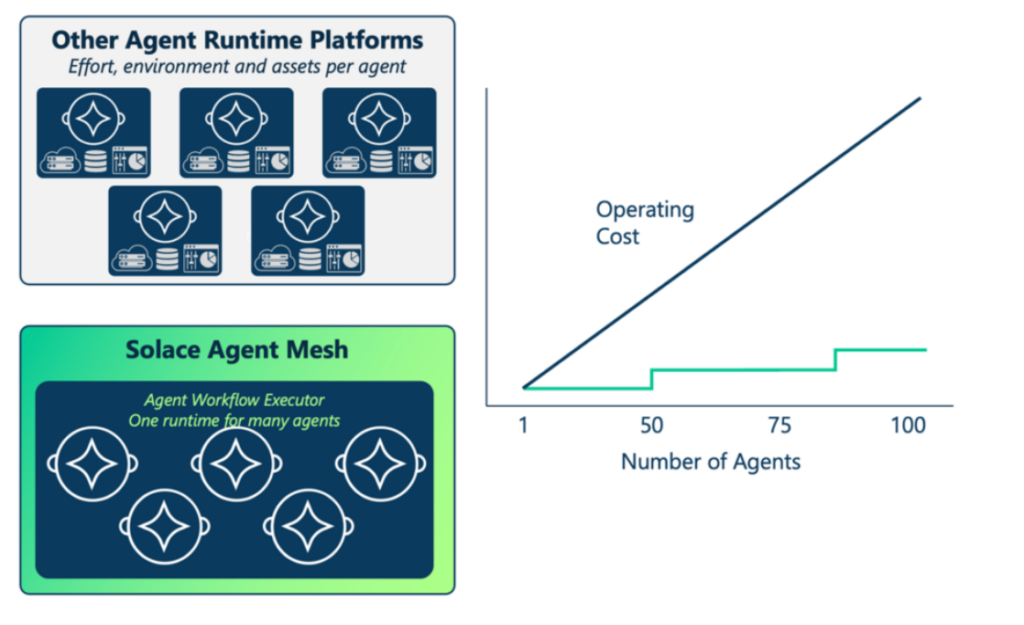
Infrastructure cost now tracks processing rather than agent count. You stand up the three components once, and because most enterprise agents run intermittently rather than continuously, you can add a meaningful number of agents onto that same fixed footprint before anything needs to scale out. New capacity gets added when a component actually runs out of CPU, not when someone defines another agent.
Token cost is handled by Smart Context Management, carried forward from the previous generation and sharpened. Instead of feeding a large tool result back into the model, Agent Mesh stores it as an artifact and hands the LLM a reference, a schema, and the tools to operate on it. The model can ask for a sum or a subtotal and get a new artifact back, without the dataset ever entering the context window.
A lifecycle, not a build step
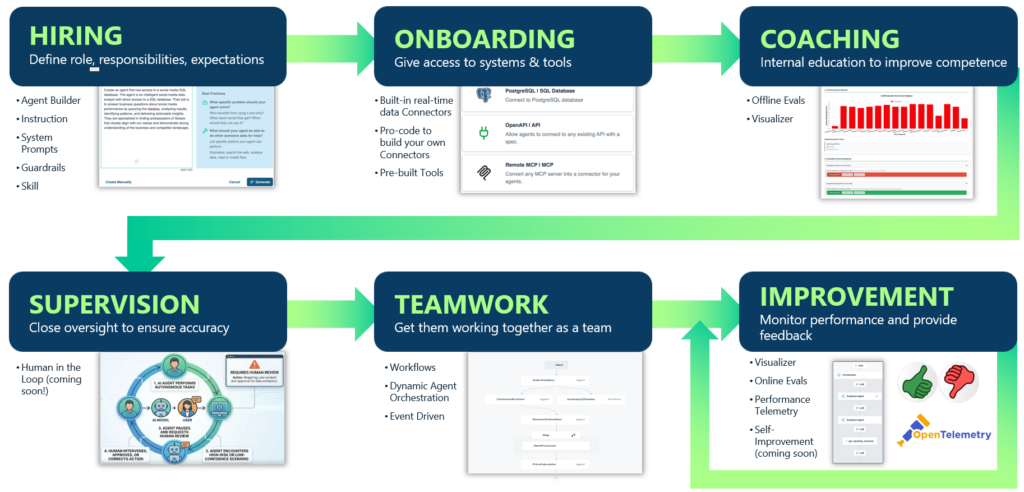
The third generation also adds tooling for the whole arc of building an agent, framed the way you would onboard a new team member: a Quick Build agent for defining the role, pre-built connectors and entrypoints for onboarding, an experiment lab with datasets and evals for coaching, human-in-the-loop for supervision, orchestration and workflows for teamwork, and observability plus online evals for ongoing improvement. An Agent Self-Improvement Loop is coming.
Get it now
Download Agent Mesh and start building. It is free for individuals and for companies under $25M/year in revenue, with no credit card required. For production traffic, deploy via Kubernetes or self-hosted, or run it fully managed on Solace Cloud.