Your Upgrade Window, Your Rules: Self-Serve Event Broker Upgrades in Solace Platform Cloud Services
Upgrading a stateful, always-on event broker is one of those operational problems that non-technical people think is simple. Afterall, it is just rebooting a server, no?
But you know that you aren’t just installing a new binary. You’re coordinating a primary and backup node through a version change, validating the service is healthy before and after, and doing all of it without a user ever noticing due to a lost event across dozens (hundreds) of applications, different queues, and different messaging patterns.
That’s changed, and the process is now easier than ever. Self-serve event broker upgrades are now rolling out broadly across Solace Platform for those using cloud services. This gives you direct control over when and how your services move to a new version. Since your applications rely on events that have order, partitions, fan-outs, consumer acknowledgement and more, this ensures that your applications can continue as expected; because your situation isn’t as simple as point-to-point.
What you can do now
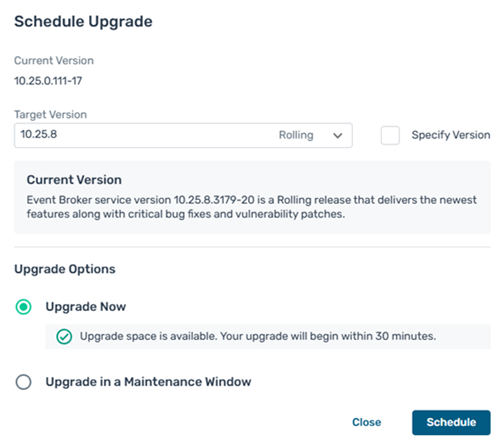
- Upgrade on your schedule. Trigger an upgrade the moment a new version is available, or define a maintenance window and let it run automatically at a time that suits your traffic patterns.
- Choose your interface. Manage upgrades from the Cloud Console or automate them through the REST API, whichever fits your existing operational tooling.
- Upgrade with confidence, not just hope. Automated pre- and post-upgrade checks validate service health before the upgrade starts and after it completes, so you’re not left guessing whether the node came back clean.
- Stay aligned with policy without babysitting it. Self-serve upgrades work hand in hand with Solace’s upgrade policies, so keeping current is a scheduled task instead of a fire drill.
Built for a platform that never stops moving
The ability to do self-service upgrades in Solace Cloud, reflects how Solace ships updates. Since June 2025, Solace Cloud has run on a two-week rolling release cadence, with an annual June release designated Long Term Support. This means that new features and security fixes land every two weeks, not once or twice a year.
A rolling cadence is only genuinely useful if staying current isn’t a burden. That’s the point of self-serve upgrades. They make it realistic to actually keep up with a platform that improves every two weeks, instead of letting a dozen releases pile up because nobody wanted to touch a production broker. The result is less accumulated security exposure and faster access to new capabilities and bug fixes, without asking you to hand over the keys to your maintenance calendar. This replaces a process where Solace used to schedule upgrades and provide more hands-on support with the process.