
In early 2026, a global energy technology company — well over 100,000 employees, operations spanning more than 100 countries — was, by any reasonable measure, ahead of the pack on enterprise AI. Its internal AI platform had roughly 30,000 active users. Eighteen business AI agents were running on it, answering employee questions, summarizing documents, working alongside Copilot, ServiceNow, and SAP agents across the enterprise.
And yet when the platform team lined up its next wave of use cases — an agent that instantly turns meeting transcripts into intelligence, an agent that reviews expense reports as they’re filed, and agents that run on a schedule with no human in the loop — they hit a wall. Everything their platform did was synchronous: a person asks, the platform answers. Nothing could react to a business event. Nothing could run while nobody was watching. One of the most mature AI adopters we’ve encountered was, in this one dimension, right back at the starting line.
This is what enterprise AI adoption actually looks like. Not a single, coordinated transformation. Not a clean progression from experiment to scale. A mosaic — vivid and sophisticated in some corners, early and tentative in others — often inside the same organization, on the same platform, at the same time, for entirely rational reasons.
Solace Agent Mesh has been in market for less than a year. In that time, we’ve talked with more than 110 enterprises around the world. We haven’t set out to write a market report, but the patterns across those conversations are too consistent, and too instructive, to keep internal.
In this piece I’ll share what we learned.
AI Is Everywhere and Nowhere at Once
Ask most enterprise technology leaders to describe their current AI program, and you’ll hear a version of the same story: three or four pilots running simultaneously, a board that wants a strategy, a team that wants six more months, and a gnawing sense that every decision made today is a bet on which cloud vendor will still be relevant in two years.
The gap between AI ambition and AI reality isn’t a failure of imagination. It’s a failure of infrastructure. And until you name the gap clearly, you can’t close it.
- One of the most candid moments in all our conversations came from a global agribusiness company, which described their current state in three words: “FOMO in the age of AI.” It was funny. It was also devastating in its accuracy. The fear of missing out is driving more enterprise AI decisions than any coherent strategy — and the result is a proliferation of isolated experiments that consume significant engineering resources but rarely reach production at scale.
- A global CPG company illustrates the pattern well. They ran an internal AI hackathon that generated over thirty ideas, narrowed to seven for serious evaluation. Over a year later, they were still deliberating between Azure, GCP, and Google Gemini as competing platform choices — even as 20,000 associates were already using an existing internal AI platform with live use cases. The challenge wasn’t finding AI use cases—it was connecting them.
- One of the world’s largest global payments networks faced a different version of the same problem. Their enterprise requirements were so specific — resilience, cost optimization, safety, privacy, production-grade reliability — that no existing solution met them. So they built their own agent framework. Then they discovered that building your own is its own kind of trap: a maintenance burden, a governance problem, and a recruitment challenge all at once.
In every one of these conversations, the same three structural challenges appear across every industry, every geography, and every level of AI ambition.
The Path to Agentic AI Success
Understanding why enterprise AI adoption looks the way it does — uneven, simultaneous, messy — requires a framework. Not to impose order on the chaos, but to make it legible. To give technology leaders a way to look at their own organization and understand what’s actually happening, and what the next move should be.
The framework we’ve observed emerging across our 110+ conversations maps degree of autonomay against existing enterprise applications/functions.
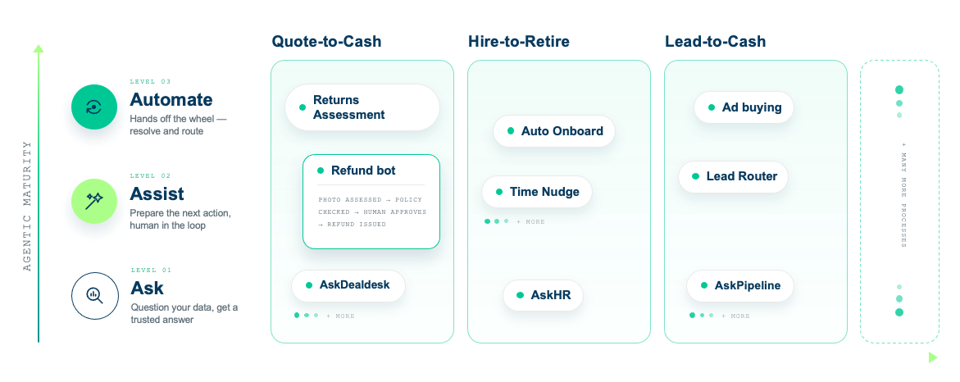
The vertical axis is autonomy. Three levels — not as a linear progression to be marched through in sequence, but as simultaneous states that different business processes can occupy at the same time:
- Ask. Human asks, AI answers. Natural language queries over structured and unstructured enterprise data. Low risk, fast to deploy, immediate value. Every organization can start here today, and many already have. This is where the first wave of enterprise AI landed.
- Assist: Something happens in a business system, and AI responds. A loan application is submitted. A sensor reading spikes. An SRE alert fires. A customer opens an app. The AI doesn’t initiate — but it reacts in real time, analyzes the situation, and keeps a human in the decision loop. This is where the second wave is now.
- Automate: AI initiates, orchestrates, and executes multi-step workflows with minimal human intervention. The agent acts on behalf of the business, across systems, over extended periods. This is where the productivity gains are transformational — and where the governance requirements are non-negotiable.
Then there is the established enterprise process categories where AI agent deployment is actively occurring across our dataset. :
| Process | What It Covers |
|---|---|
| Order-to-Cash (O2C) | Revenue operations: loans, origination, advisory, collateral |
| Hire-to-Retire | People operations: onboarding, expense management, HR workflows |
| Incident-to-Resolution | IT operations: alert triage, SRE, SDLC automation |
| Procure-to-Pay (P2P) | Supply chain: OT/IT integration, maintenance, industrial operations |
| GRC | Governance, risk, compliance: agent identity, audit, data privacy |
| Lead-to-Cash | Customer processes: CX, advisory, engagement, service |
The critical insight this framework reveals: a company doesn’t move an entire business process from Level 1 to Level 3. Different processes move at different speeds, driven by risk tolerance, regulatory environment, technical readiness, and where the business pain is greatest. A company can be at full agentic automation in one process and still evaluating its first LLM use case in another. It’s the natural, rational pattern of enterprise technology adoption.
The oilfield services company from our opening is the clearest illustration…
- At Level 1, Ask: AI agents summarizing emails and meeting transcripts for employees.
- At Level 2, Assist: an Expense Report Advisor agent, triggered by each submission, validating against policy at 150,000 transactions per month.
- At Level 3, Automate: eighteen specialized agents in production, serving 30,000 daily users, autonomously routing and processing complex business workflows. Three autonomy levels. Multiple business processes. One company. Simultaneously.
Top Agentic AI Use Cases Enterprise are Implementing
Order-to-Cash
From Data Queries to Autonomous Revenue Operations
Revenue processes have always been document-heavy, data-intensive, and ripe for automation — but the manual review cycles, the approval chains, and the reliance on human judgment have slowed them down for decades. AI agents are beginning to change that.
- Ask: One of Asia’s oldest and largest stock exchanges is giving its exchange members self-service access to collateral and trade data via natural language — something previously only available through manual file downloads or scheduled API calls. For the exchange, this isn’t just an efficiency gain. It’s a new revenue stream, built on conversational AI.
- Assist: A large Indian bank fires an AI-driven risk assessment at the moment a loan application is submitted. Not in a batch review cycle. Not after a human has manually initiated the process. The event fires, the agents activate, and a risk signal is in the hands of a decision-maker before the applicant has closed the browser tab.
- Automate: A fast-growing luxury goods retailer in India has reimagined its sales outreach entirely. An agent reads the customer’s last conversation, purchase history, and declared interest profile from CRM data — then autonomously generates personalized outreach and proposed next actions, without a sales representative having to initiate the process. A private sector bank is using agents to automate end-to-end loan origination and mortgage workflows, reducing what was a multi-day manual process to an agent-orchestrated sequence.
Hire-to-Retire
The Process That’s Furthest Along
Human resources is, counter-intuitively, one of the most advanced frontiers of agentic AI deployment in our dataset. This is partly because HR processes are well-documented and policy-bound — which makes them tractable for AI — and partly because the business case for automating them at scale is immediate and measurable.
- Ask: Every time an expense report is submitted at a major global energy services company, an AI agent validates the claim against policy, identifies exceptions, and routes accordingly. At 150,000 approval transactions per month, this is automated compliance at operational scale — not a pilot, a production system.
- Automate: The same organization’s full enterprise AI platform represents the most mature Hire-to-Retire deployment in our dataset: eighteen specialized agents, 30,000 active users, sub-30% daily active usage maintained over months. Agents handling document comparison, scheduling, meeting summarization, complex workflow routing. The sophistication of this deployment is not a preview of a distant future. It is a working system, in production, today.
A leading global asset management firm, evaluating Agent Meshfor employee digital experience improvements, has set a target of 25% productivity improvement across its workforce. The benchmark is ambitious — but based on what we’re seeing in comparable deployments, not unreasonable.
Incident Resolution
The Use Case That Hits Engineers Where It Hurts
If there is one use case where enterprise AI is generating immediate, visceral buy-in from technical teams, it is incident-to-resolution. SRE and IT operations professionals spend a disproportionate amount of their time on the least interesting part of their job: correlating logs, tracing failures, and piecing together what happened — before they can even begin to fix it.
- Ask: A major Asia-Pacific investment bank can now query its incident history in natural language. “What caused the authentication failure at 2am?” — an answer in seconds rather than hours of manual log analysis.
- Assist: One of Australia and New Zealand’s largest banking groups is building an SRE assistant that activates when an incident fires — pulling logs, correlating with historical failure patterns, and surfacing a diagnosis to the on-call engineer in minutes rather than hours. The engineers still make the call. The agent does the grunt work.
- Automate: At the Agentic Automation level, the world’s largest commercial real estate services firm is building a self-healing development pipeline: a Developer Agent implements a user story, hands it to a Scan Agent for security and quality review, passes it to a Review Agent for confidence scoring. If the threshold is met, the story closes automatically. If not, it loops back. No human in the loop unless the automated cycle fails to converge. Phase 1 scope: 500 agents. This kind of self-correcting, multi-step autonomous pipeline was also the direction articulated by a UK power generation company pursuing a “dark software factory” — a compliance and development operations system that runs without human initiation, only human oversight.
Procurement to Payment
Connecting the Factory Floor to AI
Industrial and manufacturing enterprises contain some of the richest operational data in any sector — and some of the most stubbornly siloed architectures. OT historian systems, MES platforms, SAP instances, and cloud AI services exist in separate operational planes, often with no real-time integration between them.
- Ask: Engineers at one of the world’s largest diversified mining companies can query asset health, production metrics, and maintenance histories via natural language — surfacing insights that previously required a specialist analyst and a custom report request.
- Assist: A global specialty chemicals manufacturer is building agents that respond to OT sensor threshold crossings — pulling equipment maintenance history, cross-referencing against known failure patterns, and generating a recommendation before a human engineer has seen the alert. This is predictive maintenance, not reactive repair.
- Automate: An independent US manufacturer of automotive lubrication systems — supplying production lines at some of the world’s largest vehicle manufacturers — has deployed Agent Mesh fully on-premises, connecting SAP and IBM Maximo to a locally-hosted LLM, with no cloud dependency permitted. Agents manage work orders, surface operational intelligence, and flag maintenance windows. One of the world’s largest integrated energy companies is running approximately one hundred internal AI agents through a multi-agent SAP data aggregation pipeline, producing executive briefing notes automatically from operational data.
Governance, Risk and Compliance
Governing Agents as Seriously as the Data They Touch
The GRC process column is, in many ways, the most consequential, because it is the column that determines whether all the other columns can be trusted.
As AI agents proliferate, they create a new and largely unaddressed class of compliance risk. Who authorized this agent? What systems can it access? What did it do, and when, and on whose behalf? Traditional identity and access management was designed for human users who log in, take actions, and log out. AI agents are different: they act continuously, accumulate permissions, operate autonomously on behalf of users who may not be aware of the specific actions being taken, and make decisions that carry real business and legal consequences.
- Ask: Exchange members querying compliance reports and risk exposure data in natural language is a modest but meaningful step: it replaces a process that previously required a compliance analyst, a report request, and a wait time measured in days.
- Assist: The expense report validation workflow described earlier is, at its core, an automated compliance process: 150,000 events per month, each triggering a policy validation, each generating an auditable output. The governance logic is enforced by the agent, not by human review.
- Automate: The most sophisticated examples come from organizations under the most rigorous compliance requirements. A major UK power generation company is building a fully autonomous DPIA pipeline — when a new system is onboarded or a data schema changes, an agent triggers an assessment, gathers evidence from connected systems, evaluates risk against current policy, and routes only genuinely novel situations to a human reviewer. Their north star, “a dark software factory,” is not a fantasy. It’s a technical specification.
- A major US defense contractor requires Agent Mesh deployed entirely on-premises, without containers, supporting classified environments with no cloud egress — governance and deployment requirements that most AI platforms cannot meet without significant architectural compromise. For enterprises operating at the intersection of national security and AI automation, “deploy anywhere” is not a marketing claim. It is a hard technical requirement.
Lead-to-Cash
Where the Stakes Are Highest
Customer-facing processes represent both the greatest opportunity and the highest risk in the AI agent landscape. The opportunity: personalization at scale, always-available intelligent service, proactive outreach that turns data into relationships. The risk: an AI interaction that goes wrong, at scale, in front of customers who notice.
- Ask: Customers querying their own financial data — portfolio performance, loan status, outstanding balance — via natural language is fast becoming table stakes.A public hospital system in Asia is replacing a manual appointment booking process, prone to scheduling errors and inconsistency, with an AI agent available 24/7. The expected outcome isn’t productivity. It’s trust.
- Assist: A leading Indian securities firm is firing personalized stock advisory recommendations the moment a customer opens their app, triggered by their portfolio profile and current market conditions. They are competing directly against platforms that have deployed custom small language models for the same purpose — speed and relevance of the recommendation is the competitive battleground.
- Automate: A large Indonesian mobile telecommunications operator is scaling its notification intelligence system from 40% to 100% channel coverage — adding real-time fraud detection that allows AI agents to identify and suppress fraudulent notifications before they reach customers, autonomously, at national scale. A major US airline, responding to a CIO mandate issued after a week in which fifteen flights were delayed by uncoordinated systems, is now in active deployment on gate announcement translation, ramp operations video analytics, and SWIM data grading — AI agents operating across airport infrastructure to turn operational data into real-time decision support.
The 3 Challenges All Agentic AI Implementations Face
If you Look at the examples above carefully, you’ll notice that every meaningful AI deployment runs into the same three walls challenges:
- “We built the agent, but we can’t get it into production.”
(That’s Challenge 1 — the missing lifecycle.) - “We chose Azure, but now we need to connect to Anthropic models.”
(That’s Challenge 2 — vendor lock-in, fragmenting what should be a unified capability.) - “The agent works, but it’s operating on yesterday’s data.”
(That’s Challenge 3 — batch architecture feeding a system designed for real-time action.)
Lack of a Development Lifecycle
“Who Approved This Agent?”
Traditional software has DevOps pipelines, change management processes, UAT environments, and staged production rollouts. AI agents, at most enterprises, have none of this. A developer builds an agent in a notebook. It works. It gets deployed. No formal review. No audit trail. No record of what systems it can access, what decisions it’s making, or whether anyone outside the developer’s team even knows it exists.
The consequences are already materializing.
- One of the world’s largest commercial real estate services firms — currently planning an initial 500-agent deployment for Phase 1 — has no central catalog of the agents already in production. Developers are building duplicates without knowing equivalent agents exist across other teams. Idle agents are generating cloud costs with no visibility. Security teams are finding AI in production that was never reviewed.
- The most precise articulation of this challenge came from the cybersecurity engineering leadership at a major global oilfield services company. After deploying eighteen agents to 30,000 employees, their team was explicit: they require formal “gates” before any agent reaches production — documented ownership, stated business value, contextual justification for every system the agent can access. In their words: a digital license to operate.
- A leading UK energy utility articulated the same gap from an operational perspective: no kill switches, no way to dynamically monitor what agents are doing, no uniform registry that teams enterprise-wide can consume. They described what they actually needed as a “shared, inner-sourced foundation — governance enforced top-down.”
Challenge 1: There is no lifecycle for AI agents
No governed path from “a developer built this” to “IT and the business have approved, deployed, and can audit this.” Until that lifecycle exists, agent sprawl is inevitable — and so are the costs, security risks, and compliance exposures that come with it.
Vendor Lockin
Every Cloud Wants to Be Your Only Cloud
Cloud hyperscalers are each building agentic AI platforms. They are excellent within their own ecosystems. The problem: no large enterprise is — or will ever be — 100% on one cloud. Different teams made different technology choices. Different acquisitions brought different platforms. Different regions have different regulatory requirements. Multi-cloud is not a planning failure. It is the inevitable structural reality of distributed enterprise decision-making.
And every hyperscaler’s agentic framework is designed, implicitly or explicitly, to keep you inside their walls.
- A global consumer goods company selected Google Gemini Enterprise as their central AI hub for associates — a deliberate, well-reasoned decision. Within weeks, they realized they still needed to connect agents built on Azure, Microsoft Teams, LangChain, and SAP. No single hyperscaler, however comprehensive their roadmap, can absorb an enterprise technology estate built over twenty years across multiple clouds, ERP platforms, and legacy systems.
The competitive dimension of this challenge deserves direct acknowledgement: in one of the Indian financial services conversations in our dataset, a major technology vendor was not just competing for the AI orchestration layer — it was proposing to own the entire platform, the productivity suite, and the CRM layer, packaged as a single comprehensive solution. Lock-in presented as simplicity. This is a commercial strategy, and enterprise technology leaders need to recognize it as such before they sign.
Open-source frameworks , like Langchain, offer developer flexibility but don’t resolve the enterprise governance, security, or scale challenge. They are useful building blocks. They are not enterprise infrastructure.
Challenge 2: Vendor Lock-in in the Agentic Tooling Market
.
It is being actively pursued today, by every major hyperscaler and model provider.
Stale Context
“You Can’t Automate Yesterday’s Data”
Here is the most underappreciated architectural insight in enterprise AI: the majority of large-enterprise data architectures are still batch-oriented. Data moves on schedules. Systems are polled on intervals. Overnight jobs synchronize databases. This architecture was rational and cost-effective for the BI and analytics era.
It is fundamentally incompatible with agentic automation.
An AI agent that detects a problem in your production environment at 2am, using data from last night’s batch job, is not an intelligent system. It is an expensive cron job. An AI agent that validates a loan application in real time, against a risk model fed by current market data and live transaction history, is a different kind of system entirely — one that can actually change business outcomes.
- A major UK retail bank — in the process of migrating from a legacy message broker to a modern event-driven architecture — captured this exactly: “All their systems are polled. They want to move from pull to push.” They weren’t describing a technology preference. They were describing the prerequisite for making AI agents actually work.
- A bank in India was equally direct. Their stated requirement for an AI-powered loan and credit card platform was not low latency as a performance metric — it was low latency as a product requirement. Real-time risk assessment at the moment of application submission, not in a batch review cycle hours later. For a bank processing millions of transactions, the difference is not technical. It is commercial.
- A global specialty chemicals manufacturer operating across multiple continents has petabytes of operational data in OT historian systems — sensor readings, equipment telemetry, process parameters — that could power predictive maintenance agents capable of preventing failures before they occur. But the data is operationally siloed. It cannot reach AI systems in real time. The agents they want to build cannot act on data they cannot see as it happens.
Challenge 3: Agentic AI without real-time data is just a smarter chatbot.
The event-driven backbone — the infrastructure that makes data available to agents at the moment it changes, not hours later — is not an optional component of an AI architecture. It is the foundation.
These three challenges are often discovered only after a proof of concept succeeds and the team begins to think about scale. The PoC worked in one team’s environment, with one cloud, with one data source — and now the question of enterprise rollout exposes every assumption that was baked into the design.
Requirements for Agentic AI Infrastructure
Across all our conversations, five requirements appear with enough consistency to be treated as table stakes for enterprise-grade agentic AI.
Lifecycle Management
Every enterprise we speak to can build an agent. Very few have a repeatable way to get one safely into production — and keep it performing once it’s there. An agent is less like a new application and more like a new employee: it has to be hired with a defined role and clear boundaries, onboarded with governed access to systems and tools, coached through evaluation before it faces real work, supervised with a human in the loop where the consequences are real, and measured and improved on the job. The infrastructure has to carry every agent through that lifecycle the same way, every time, for every team. What one of our customers called a “digital license to operate” — formal gates an agent must clear before it touches any production system — is not a wish list item. It is the difference between a portfolio of pilots and AI that actually ships.
Vendor Agnostic
No enterprise will — or should — standardize on one LLM, or one cloud. The infrastructure must work across multiple clouds, frameworks and open standards like MCP, and A2A, without requiring a rebuild. Multi-cloud or Multi-model is not a problem to be solved by choosing the right vendor. It is a structural condition to be accommodated by choosing the right infrastructure that makes that choice less important.
Event-Driven / Real-Time
The distinction between event-driven and polling-based architectures is technical in description and transformational in consequence. An agent that receives a real-time event reacts to the world as it changes. An agent that polls for data on a schedule reacts to a reconstruction of how the world was. For SRE, financial risk management, industrial operations, and customer engagement, that difference determines whether the AI system is actually useful — or just expensive.
Deployable Anywhere
A global manufacturer has cloud infrastructure at headquarters and air-gapped OT networks on factory floors. A defense contractor operates in classified environments with no cloud egress permitted. A bank in India has data residency requirements that preclude SaaS deployment. The same governance model and the same agent communication fabric must work in all of these environments, without architectural compromise.
Observable and Governable
As agent counts scale from five to five hundred to five thousand, the ability to visualize workflows, trace agent interactions, audit decisions, and enforce policies transitions from a useful dashboard to a core operational requirement. You cannot govern what you cannot see. And at enterprise scale, what you cannot govern, you cannot trust.
—
Solace Agent Mesh was built to these requirements — not retrofitted to meet them. It gives enterprises a full agent development lifecycle for building agents and safely graduating them into production, on an event-driven runtime that Solace has hardened over twenty-plus years of enterprise messaging — so agents operate on the world as it changes, in real time.
The governance, security, and deployment flexibility that customers keep raising are built into that lifecycle and that runtime, not bolted on as features.
How far along the path to agentic AI success are you?
Every enterprise is already somewhere on the autonomy × business process matrix — whether they’ve mapped it or not. The first challenge is understanding where you are today, where you’re trying to get, and what infrastructure decisions you need to make to get there without rebuilding everything when the next challenge appears.
Experimentation
In early days, an enterprise might have multiple PoCs running, high enthusiasm, growing anxiety about which framework to standardize on, and a board that wants an AI strategy by the next quarterly review.
The signature behavior: running three to five independent pilots across different clouds and frameworks simultaneously, with no common infrastructure. The risk is that each successful PoC creates a new silo.
The Recommendation
Keep experimenting — just resist letting every pilot pour its own foundation. Don’t consolidate prematurely on any single cloud, model, or framework; that choice will keep changing, and it should. Do standardize the layer underneath: how agents communicate with each other, how they’re governed and licensed into production, and how they’re observed once they’re there. It is far easier to lay that foundation under your first five agents than to retrofit it under fifty live ones.
Expansion
Organizations with a few use cases in production frequently face questions PoC environments were never designed to answer. How do we replicate this pattern across teams? How do we govern it across business units that didn’t participate in the original build? How do we connect it to the rest of the business without rebuilding from scratch?
The PoC worked for one use case in one team. The infrastructure question is: can the same pattern run fifty times without fifty independent engineering efforts?
The Recommendation
The bottleneck is almost never the agent. It’s the integration, agent lifecycle governance, and data access layer that the PoC assumed away.
Operation
Many enterprises with multiple agents in production across multiple business units faces the consequences of early decisions made at speed: agent sprawl, cost visibility gaps, security reviews triggered by production incidents, and parallel requests from different teams each wanting a different AI framework.
The recommendation: rationalize the infrastructure layer. Not the agents themselves — diversity of agent frameworks is expected and manageable. The communication fabric, the governance model, and the observability tooling need to be unified, because without them, every new agent addition can increase complexity rather than capability.
Improvement
Very few of the customers we spoke to are here yet — and the ones who are will tell you the ground is still moving. But their signals are remarkably consistent. With dozens of agents in production, knowing what to improve, and where, has become a forensic exercise: models drift, prompts age, tools change underneath the agents that call them, and the teams that built those agents have moved on to building the next ones.
The phrase we hear, in different words, from them: “we can’t keep up.” And the ask that follows is just as consistent — agents that notice when their own performance slips and correct it. Self-healing or self-improving agents.
The Recommendation
Treat self-healing as a destination, not a feature to wait for. An agent can only heal what it can measure and can only ship a fix safely through a lifecycle with gates. The organizations that get self-healing agents first won’t be the ones that waited — they’ll be the ones already running evaluation and telemetry on every production agent and actively discussing with vendors their plans in this direction , so that closing the loop is an upgrade.
The Agent Infrastructure Imperative
The diversity of use cases in these conversations is a sign of maturity. Enterprises are adopting AI where it makes operational sense, at a pace that reflects their risk tolerance, regulatory environment, and technical readiness. That is exactly how transformative technology should move through large organizations.
The companies moving fastest are not the ones who chose the best LLM. They are not the ones who committed earliest to a single cloud platform. They are the ones who recognized, early enough to act on it, that the model is not the constraint. The infrastructure is.
The three challenges — agent lifecycle, vendor lock-in, real-time data — don’t resolve themselves as AI technology matures. More agents mean more lifecycle complexity. More clouds mean more fragmentation. More reliance on AI-driven action means more exposure to stale data. The infrastructure layer is not a technology decision that can be deferred until the agents are built. It is the precondition for building agents that work at enterprise scale.
The best time to lay the foundation was before you had fifty agents. The second-best time is now.