
Introduction
Enterprises are evolving from generative AI to agentic AI, where autonomous agents reason, coordinate, and act across multi-step workflows. While the promise is significant, moving from experimentation to production comes with challenges such as fragmented and outdated data, brittle integrations, and agent sprawl—all of which result in rising operational costs.
Mastering these challenges requires more than better models or frameworks—it demands an enterprise-grade agent mesh architecture. This article outlines how a new kind of software called an agent mesh, AI governance platforms emerging from API management, and identity providers provide that foundation. By combining event-driven agent orchestration with AI governance, security, and management built on API management principles, organizations can turn isolated agents into a resilient, governed, and scalable agentic ecosystem.
Strengthening AI Governance and Agent Orchestration
For the enterprise, the journey toward autonomous AI begins with the foundation of existing assets already in place. Most organizations have spent years becoming “API first,” building out event-driven microservices and establishing domain-driven architectures where business functions are exposed through well-defined APIs and events. Many of these assets are governed by established API Management (APIM) platforms. However, to move beyond simple chatbots, enterprises now need a way to connect their AI “brains” to these real-world systems and to each other without creating a “governance black hole” of fragmented, insecure agents and tools that operate without clear ownership, policy control, or accountability.
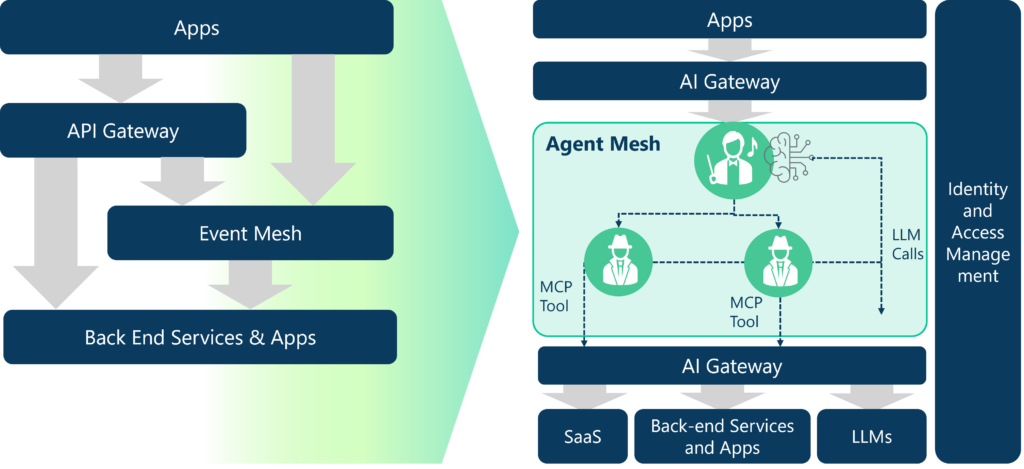
To achieve this, customers should adopt a three-pillar architecture that places equal weight on agent orchestration, AI governance, and identity management.
Pillar 1: Orchestrating the Agent Ecosystem with an Agent Mesh
An agent mesh, like our own Solace Agent Mesh, provides the production-ready runtime environment required to coordinate specialized agents at scale. Rather than relying on static, rule-based logic, an agent mesh enables agents to analyze real-time business context—such as live inventory levels or customer history—before making decisions. Orchestration is only part of the job. An agent mesh also carries agents from first build through testing, deployment, and day-to-day operation, so teams don’t rebuild that tooling on every project.
- Asynchronous Coordination: Agent meshes use an event-driven backbone, allowing agents to communicate asynchronously. This ensures the architecture is decoupled and can scale to handle the speed mismatches between different models and legacy systems.
- Multi-Framework Orchestration: It provides a unified environment to orchestrate agents built across various third-party frameworks like LangChain or Amazon Bedrock, allowing teams to use the best tool for the job.
- Dynamic Workflows: Agent meshes support both structured and dynamic orchestration, enabling agents to build new skills and execute complex, multi-step tasks reliably.
Pillar 2: Governing AI Connectivity with an AI Gateway
Complementing the orchestration layer, an AI gateway acts as a unified control plane for managing APIs, event streams, and LLM access. By reusing existing APIM technology, IT teams can secure and monitor new AI interfaces with the same rigor they apply to traditional APIs.
- Enforcing Guardrails: An inbound AI gateway applies consistent security policies, such as PII detection and rate limiting at the user or channel level, to protect sensitive enterprise data.
- Transforming APIs into AI Tools: Using Model Context Protocol (MCP), domain owners can turn their existing, proven REST APIs into machine-readable tools for agents. This preserves all existing validation and business logic while accelerating time-to-market.
- Observability and Cost Control: An outbound gateway serves as an abstraction layer for various LLMs, allowing organizations to track token usage and prevent “bill shock” while providing a single pane of glass for LLM usage metrics.
Pillar 3: Identity Management and Authorization for Agents
While orchestration and governance define how agents interact, identity management establishes who is allowed to do what. As agents become autonomous actors within enterprise systems, they must be treated as first-class identities rather than anonymous processes or impersonated users.
- Agent-Specific Identities: Each agent is assigned a unique, verifiable identity, enabling strong authentication and traceability across agent-to-agent, agent-to-tool, and agent-to-system interactions.
- Delegated Authority: Identity and authorization systems ensure agents act only within explicitly delegated permissions—maintaining clear chains of responsibility when agents operate on behalf of users or other systems.
- End-to-End Trust Boundaries: By integrating agents, tools, APIs, and backend services into enterprise identity, organizations can enforce consistent authorization policies and generate auditable records that distinguish human actions from autonomous agent behavior.
Why Adopt This Architecture?
By integrating an agent mesh with AI governance and identity management, enterprises create a vendor-neutral and future-proof platform that scales from initial proofs-of-concept to petabyte-scale deployments. This approach maximizes the ROI on existing assets by favoring governed APIs over brittle, direct-to-database connectors. Ultimately, this combined architecture ensures that your agentic workflows are not only intelligent and context-aware but also secure, auditable, and production-ready.
Towards the Agentic Enterprise
Enterprises are moving from generative AIs that create content to agentic AI systems that carry out complex work. AI models supply the “brains,” and single agents can be created rapidly, but teams struggle to take multi-agent systems from pilot to production.
A big part of the problem is that data is scattered across enterprise resources, services, and APIs, not to speak of providing relevant real-time context. AI itself is often the easy part. According to Deloitte’s AI trends 2025: Adoption barriers and updated predictions, enterprises face organizational challenges regarding integration with legacy systems and governance, risk, and compliance.
Legacy infrastructure is often inflexible, making it difficult to connect autonomous agents. This can be addressed by platform modernization and API-led and event-driven integration. Delegating decisions to agents is risky. Current AI governance addresses general AI safety, bias, privacy, and explainability, but not autonomous systems. There’s a need for governance models, guardrails, and policies.
Without the right architecture in place, you end up with agent sprawl. Agents appear, and it is unclear who owns them. As a result, there are no consistent guardrails or visibility into what they’re consuming or costing.
Synchronous request-response patterns break down with long-running AI tasks. If an agent pauses or a model takes seconds to respond, everything behind it ends up waiting, which might cause the workflow to fail or result in unacceptable response times.
That’s why you need an agent mesh and AI governance. The combination provides the backbone that orchestrates agents, links agents to enterprise systems, tools, and other agents with strong security and governance.
Building Blocks of the Agentic Enterprise
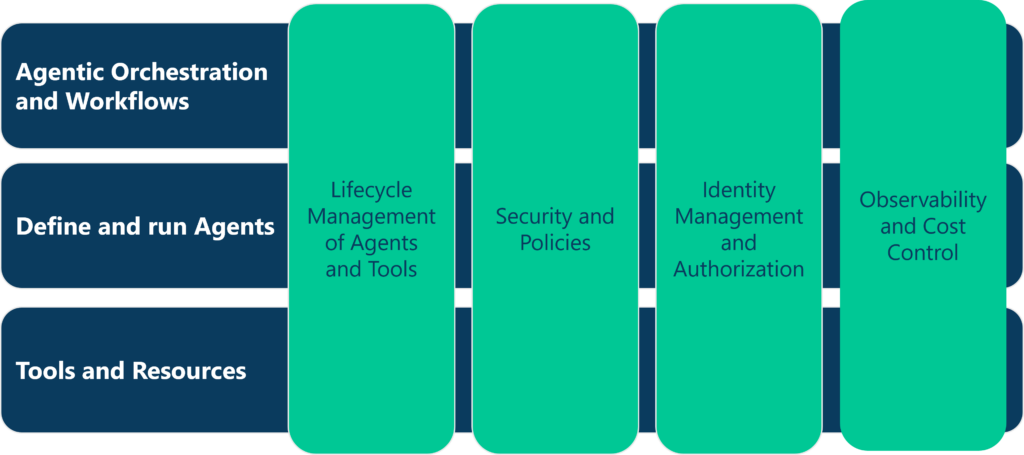
Three building blocks are required to meet the challenges of agentic AI in the enterprise:
- Agentic orchestration and workflows
- Defining and running agents
- Making tools and resources available to agents
To address governance concerns across these three capabilities, you’ll need:
- Lifecycle management of agents and tools
- Security and policy enforcement points
- Identity management and authorization
- Observability and cost control
Define and Run Agents
Developer tools—such as IDE plugins and agent-building frameworks—help developers design, test, and refine AI agents. Frameworks for coding and running agents provide structured ways to define agent behaviors, reasoning, and action capabilities, ensuring they can safely operate and make context-driven decisions. Together, tooling and frameworks accelerate development. Agent mesh platforms are increasingly absorbing these steps too. Where they don’t, every team ends up assembling its own toolchain, and no two agents get built the same way.
Agentic Workflows and Orchestration
Agentic orchestration breaks down prompts into multi-step tasks and coordinates autonomous agents reliably and efficiently. This shifts AI automation from isolated actions to end-to-end complex tasks and processes. Orchestration layers coordinate agent actions to ensure that the right agent is activated at the right time. Agents rarely operate effectively in isolation. Complex enterprise processes demand that specialized agents collaborate, share context, and hand off tasks seamlessly. Agentic orchestration enables scalable, predictable automation that adapts to changing conditions and business goals.
Tools and Resources
These are the foundation that enables AI agents to act, retrieve information, and interact with systems. Tools—such as APIs, databases, and business systems—extend an agent’s capabilities, allowing it to update records, process transactions, or execute business logic. MCP plays a key role by standardizing how these tools are described, discovered, and invoked, giving agents a consistent way to access diverse capabilities. Standardized tool integration ensures agents remain adaptable and capable of performing meaningful tasks.
Lifecycle Management of Agents and Tools
Just as any other IT asset, agents and tools need to be subject to life cycle management so they are aligned with enterprise standards throughout their entire operational lifespan. Strong lifecycle practices allow teams to update, deprecate, or refine agents and tools over time. This preserves trust and ensures predictable behavior. Solace Agent Mesh handles this in a single workflow: an agent is defined, built, and tested, then deployed, monitored, and refined in the same place it was created.
Security and Policies
These provide the guardrails, so AI agents operate safely, predictably, and within boundaries. Effective controls include rate-limiting and token-usage policies that prevent runaway costs. Prompt guardrails, decorators, and policy-as-prompt techniques help enforce least-privilege principles and block out-of-scope or risky requests. Additional layers—such as input/output filtering, safety checks, and approval workflows—ensure agents operate in defined security boundaries.
Identity Management and Authorization
Provides the security foundation that allows AI agents to operate within clearly defined trust boundaries. Modern identity management introduces agent-specific identities that authenticate autonomous agents using verifiable, token-based credentials. Each agent has a unique, traceable digital identity tied to its permitted actions, and delegated authority maintains auditable chains of responsibility and follows minimal-access rules when agents act on behalf of users or other systems.
As AI agents spread across enterprise IT, identity platforms must also provide scalable mechanisms for fine-grained authorization, limiting each agent’s access to the systems, data, and tools appropriate to its role.
Observability and Cost Control
These are essential to operating multi-agent systems. Numerous agents make independent decisions, invoke tools, and generate unpredictable cost patterns. Agentic AI creates dynamic, non-linear workflows with prompts resulting in multiple tasks, agents working and calling tools in parallel. Traditional logs become insufficient for understanding behavior or attributing costs accurately. Observability for agentic AI provides structured traces capturing each agent’s reasoning, tool calls, and decision paths, which enable teams to track dynamic dependencies between agents and understand why costs or latencies increase.
Cost-control mechanisms—such as real-time token attribution, per-agent budget enforcement, and automatic throttling—prevent cost overruns when multi-agent workflows expand in complexity or agents repeatedly invoke tools.
Combined, observability and cost governance provide the visibility needed to ensure multi-agent systems remain reliable and economically sustainable.
Agent Mesh, API Governance and Identity Management
In the section above, we have described the building blocks of agentic AI at scale. But where do you get these from? Should you build or buy? And when buying components or support for open-source tools, what are good choices.
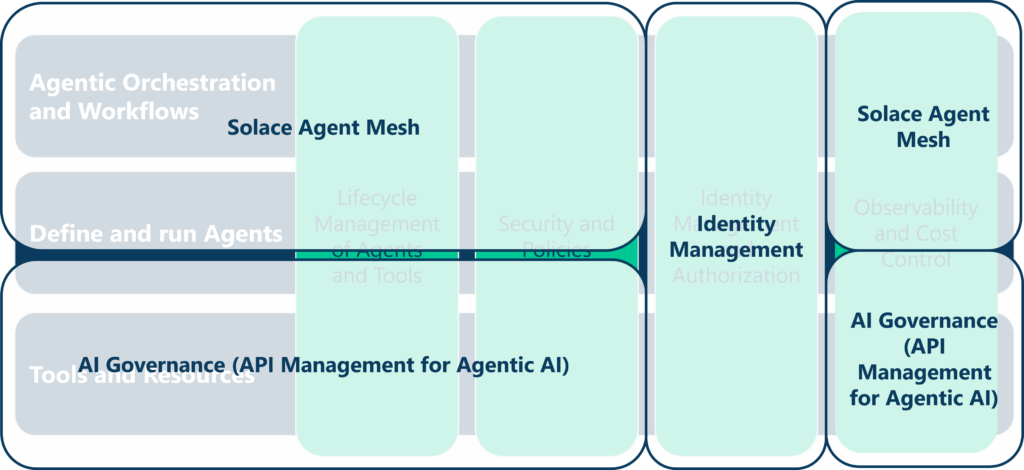
A good starting point is a combination of
- Agent Mesh
- Define and run agents
- Utilize built-in tools
- Orchestrate agents
- Secure agent and tool interaction
- Manage the lifecycle of agents
- Observe and trace end-to-end dynamic agent workflows
- AI Governance (API management evolved for the agentic era)
- Create and expose tools as MCP Servers
- Expose existing APIs as MCP Servers
- Manage the lifecycle of tools and agents
- Apply security and policies for tools, agents, and LLM access
- Observe tool, agent, and LLM metrics and analytics
- Identity Management and Authorization Server
- User and application client management
- Support for OAuth and OpenID Connect
- Token mediation and federation
Agent Mesh: Event-Driven Orchestration
An agent mesh like our own Solace Agent Mesh is an event-driven platform that lets you create and manage agents as well as orchestrate agents in real time. An agent mesh serves as the connective layer for AI components. Agents can exchange information asynchronously with other agents, tools, APIs, and enterprise systems.
From this point on, we’ll discuss Solace Agent Mesh specifically, but most agent mesh products should provide similar functionality.
In Solace Agent Mesh, the Orchestrator Agent transforms a high-level prompt into tasks and sends each task to the right specialized agent. It supports dynamic orchestration for open-ended tasks and prescriptive orchestration for workflows that need to adhere to strict rules. Runtime orchestration is not the whole product. The components shown below (Agent Builder, Agent Coding, Deployer, Visualizer) cover the development side: how agents get built, shipped, and watched once they are running.
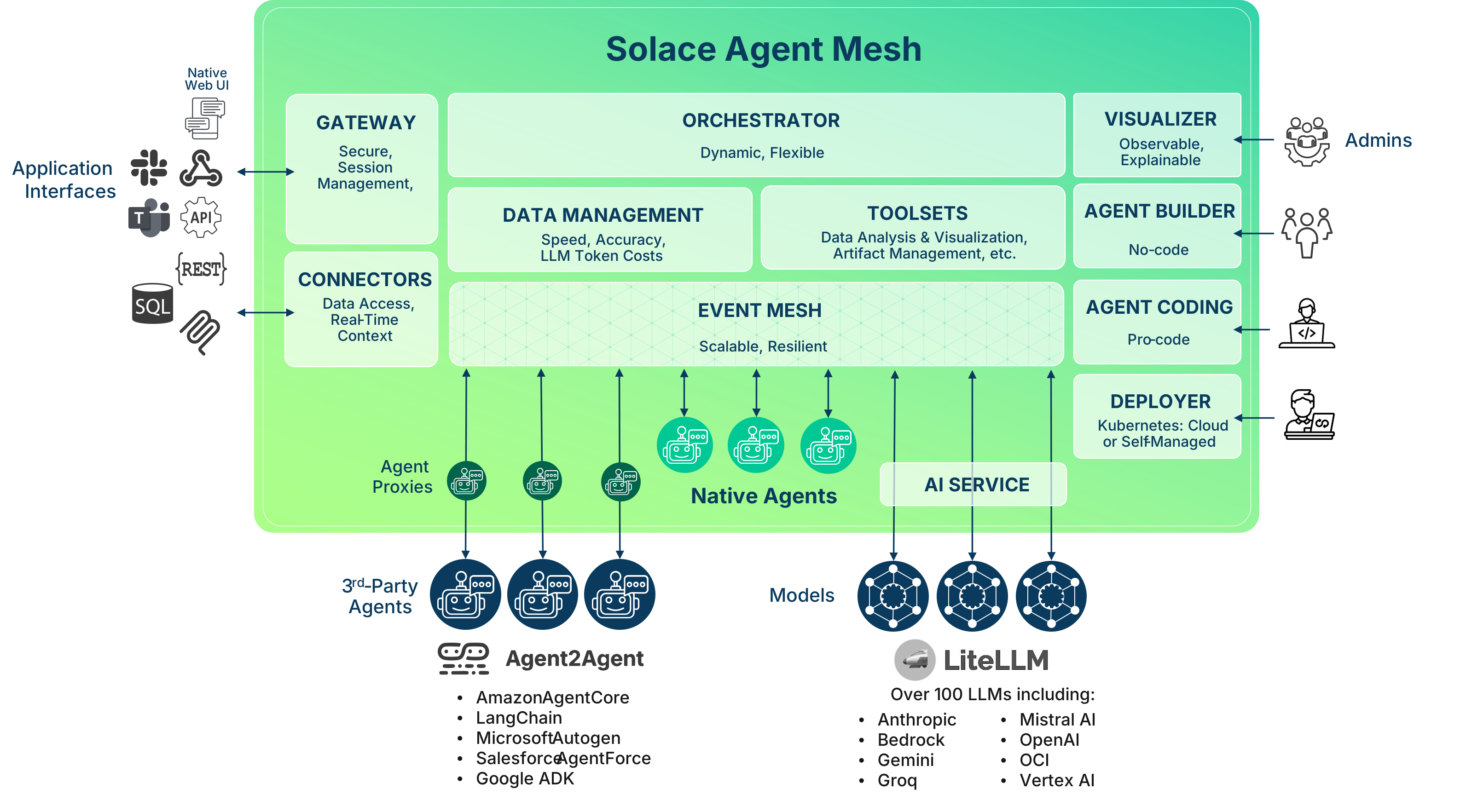
Because Agent Mesh is built on a broker-centric, event-driven architecture, agents can run in parallel. Each one operates independently, without blocking other agents, so the system stays responsive and can trigger self-healing even when an agent is slow or failing.
Agent Mesh provides only the data or context an agent needs. This keeps model costs under control and reduces unnecessary processing, which often also increases response times. Agent Mesh makes it easy to build event-triggered assistants that respond to significant events; for example, the moment inventory runs out or a customer raises a complaint.
Agents are defined by configuration-driven YAML files and can be built through an AI-assisted, no-code builder for business experts and pro-code tools for technical teams. They run on a resilient event-driven backbone that supports asynchronous parallel processing and dynamic discovery through standardized Agent Cards.
API Governance: Governance and Security
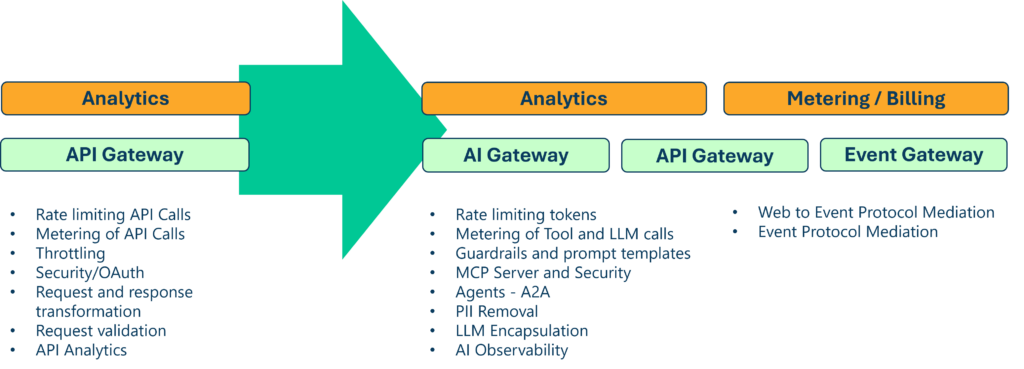
AI gateways and agent management evolve from API gateways and API governance. They apply API-management principles to agentic AI, providing a centralized control plane to secure, govern, and manage the agentic ecosystem. AI gateways manage the lifecycle of agents and give teams a management pane for governance and monitoring.
Some AI gateways offer agent catalogs where teams can find and reuse AI agents and tools.
Each agent appears as an agent card that shows its identity, capabilities, and required authentication, such as API keys or OAuth 2.0.
Many AI gateways expose agents based on the Agent2Agent (A2A) standard and enable you to enforce identity checks and prompt guardrails. You can block harmful inputs and prevent prompt-injection attacks. You can also ensure agents only access the data they’re authorized to use.
The AI gateway tracks tokens in LLM requests and responses, so teams can monitor usage, forecast spend, and apply quotas.
API gateways and analytics add these policies and additional protocols, extending the capabilities of API management into agentic AI.
AI gateways can automatically convert APIs that are documented by an OpenAPI specification into an MCP tool server. This lets AI agents discover and securely invoke legacy REST APIs without manual backend changes.
Identity Management and Authorization
Vendors of identity providers, single sign-on, infrastructure, and access management solutions are adapting their products by treating agents as first-class identities. They provide the security foundation for agentic AI, shifting from insecure and poorly auditable mechanisms like user impersonation and token pass-through to explicit delegated authority.
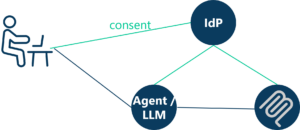
Identity systems establish a verifiable “who” for every action, ensuring that ephemeral agents are properly authenticated and authorized to access resources on behalf of users. They enforce least-privilege policies and produce audit logs that distinguish actions taken by a human from those taken by autonomous agents.
They need to support the security mechanisms mandated by emerging standards such as MCP and A2A, which lean heavily on OAuth 2.1, OpenID Connect, and related standards. To handle transient agents, they need to support Dynamic Client Registration, which allows agents to autonomously register and obtain credentials. Furthermore, products are adopting cross-app access patterns to maintain a user’s authorization context securely as agents move across different organizational trust domains.
Putting it all Together: Governing, Protecting, and Orchestrating AI Agents
Together, AI governance products such as AI gateways, agent management tools that are emerging from the API management space, Solace’s event-driven agent orchestration, and identity management (standalone or as part of an AI governance platform) yield a well-governed agentic AI ecosystem without agent sprawl.
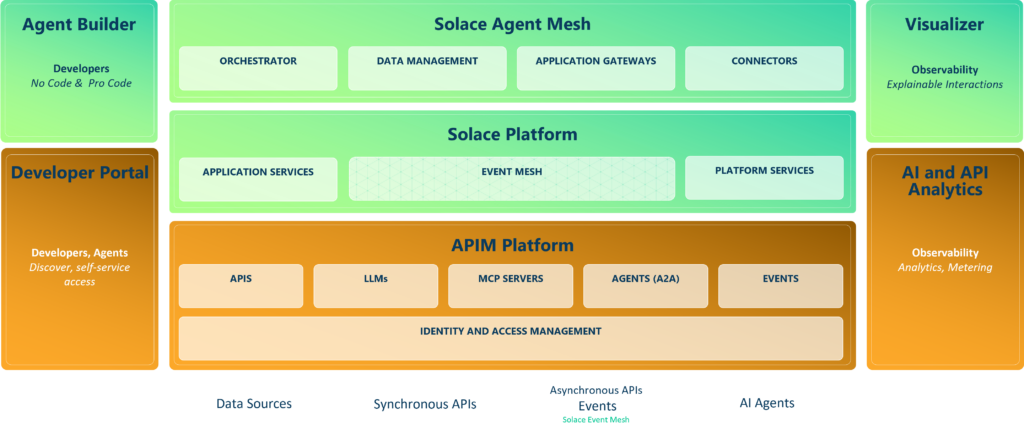
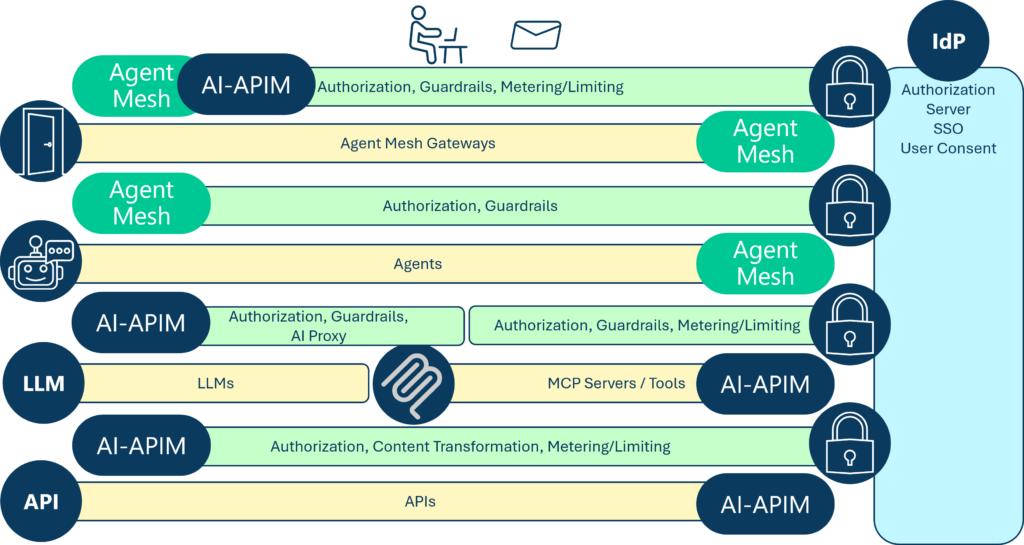
AI gateways provide the centralized control plane—an AI governance and agent management platform—that not only secures entry points and enterprise resources but also governs and protects the agents and tools that Agent Mesh orchestrates. They apply authorization, guardrails, and metering at the gateway, enforcing security across all governed LLMs, agents, and tools.
Agent Mesh provides the intelligent orchestration backbone that coordinates complex, multi-agent workflows. Agent Mesh’s Orchestrator decomposes the prompt into subtasks and routes these to the right specialized agents.
Identity Management provides end-to-end security at every level of interaction—human to agent, agent to agent, agent to tool, and so on. It may be embedded into the API platform or a standalone solution such as the enterprise identity management system that is already in place.
Agent Mesh and AI Gateway Integration Models
MCP (Model Context Protocol) Tooling and Automated Discovery
- Expose, manage, and secure access to enterprise resources and tools
- Accelerate exposure of MCP tools to agents by reusing existing APIs
Enterprises often have large portfolios of REST APIs that aren’t “AI-ready.” AI gateways provide MCP tool server support, which closes this gap by turning existing APIs into tools with just a few clicks. They use APIs’ OpenAPI specifications to automatically create machine-readable tool definitions. These tools carry an enterprise-grade security model, preventing agents from accessing data they shouldn’t.
Developer portals evolve into tool and agent registries that are in turn exposed as MCP servers. That means Agent Mesh’s Agent Builder can automatically discover them, allowing developers to assemble new capabilities from trusted, pre-secured assets.
Secure External Access to Agentic AI
- Secure external access to Solace Agent Mesh
- Enable remote, 3rd party access
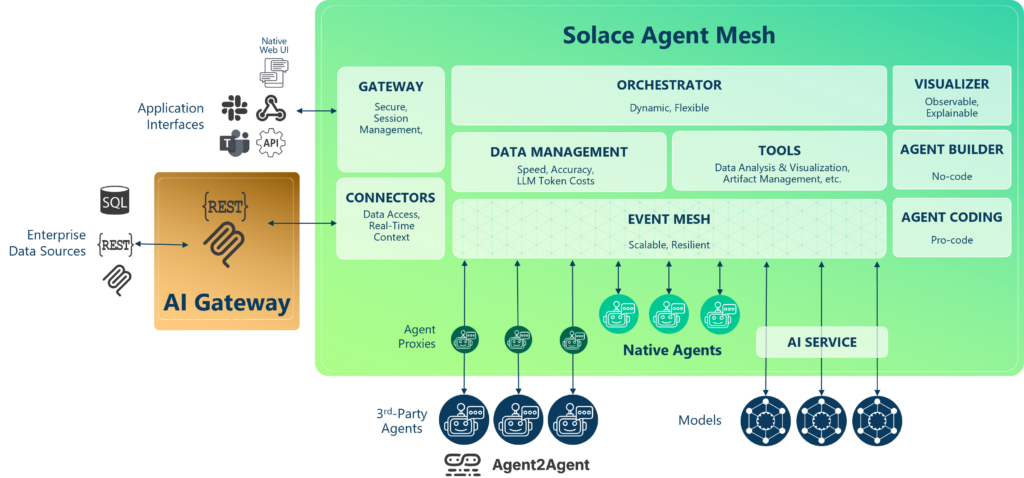
Agent Mesh comes with a variety of gateways to interact with agentic AI. There are foundational gateways such as Web UI and REST API. Event Gateway allows data being routed by Solace Event Brokers to trigger agentic workflows, and enterprise collaboration and chat gateways for Teams and Slack complete the picture.
However, if you want to make Agent Mesh accessible to partners or customers, an AI gateway can be used to securely expose the Agent Mesh REST API externally, with your AI and API governance platform’s developer portal providing self-service access to external parties.
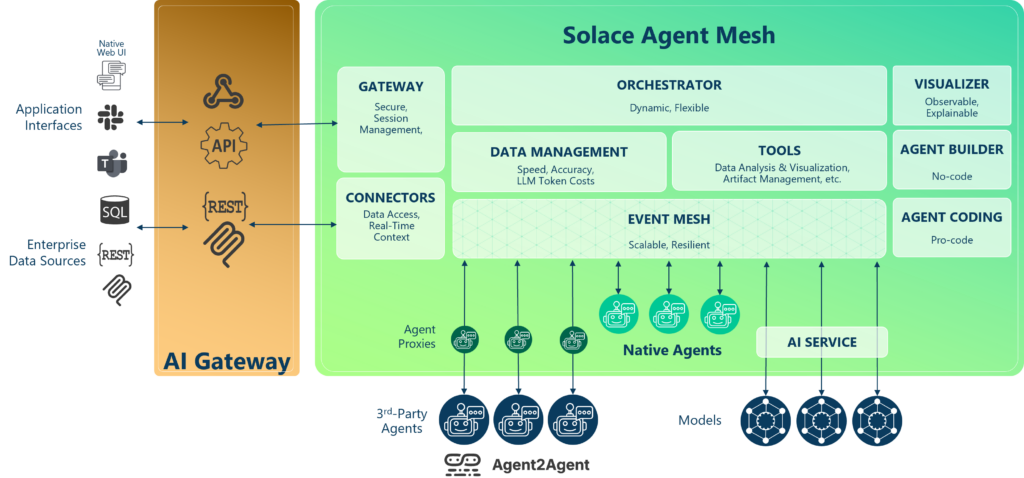
Encapsulate And Govern LLM Usage
- Encapsulate LLM providers and manage consumption (tokens)
- Monitor and control LLM access and costs
Organizations are increasingly adopting multi-LLM strategies to avoid vendor lock-in. Utilizing different models means enterprises can tailor their choice of LLM to specific functional domains, such as customer service, HR, or data analysis.
Effectively managing access across these diverse models requires a secure abstraction layer between agents and LLM providers, typically provided by AI gateways. One aspect is the enforcement of context-aware prompt guardrails that inspect incoming prompts for PII violations, harmful intent, or jailbreak attempts. Beyond security, cost management and attribution is also a primary concern. To manage the unpredictable compute costs associated with agent interactions, AI gateways apply real-time token tracking, token-based rate limiting, and usage-based billing.
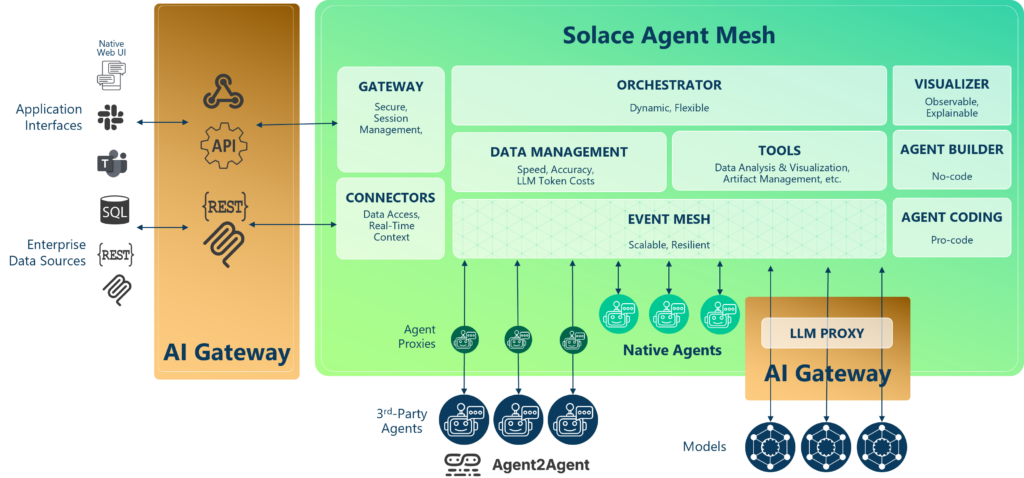
AI Gateway for Agent Governance and Lifecycle Management
- Expose, manage, and secure access from Solace Agent Mesh to Agents
- Apply guardrails and prompt templates
To prevent agent sprawl, organizations need a lifecycle management layer. In this model, an AI Gateway acts as a secure A2A front-end—an agent gateway—for agents wherever they run.
Governed agents are registered in the AI gateway’s agent catalog with their agent card. These cards provide information about the agent’s identity, skills, and security requirements. Agent Mesh uses these cards to integrate agents into complex, multi-agent agentic workflows.
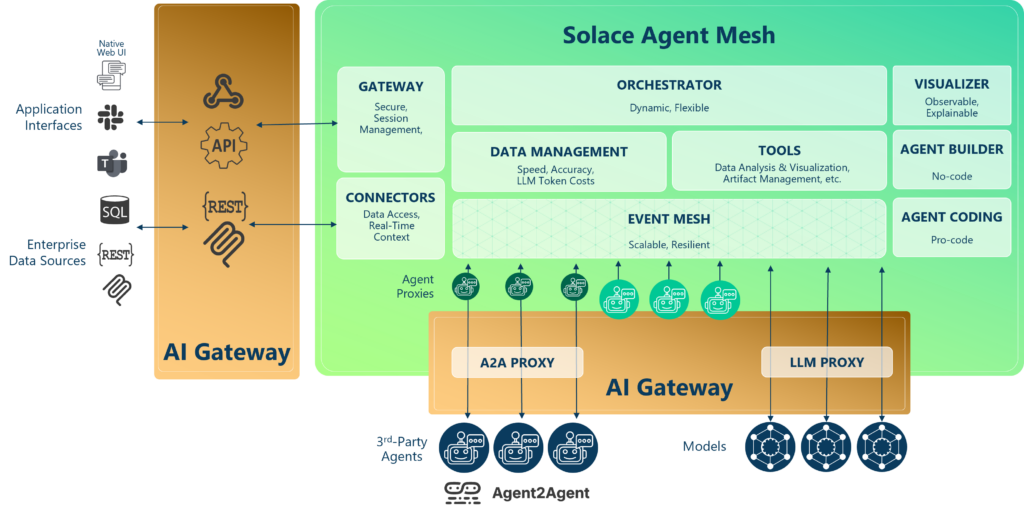
The AI gateway proxies interactions between Agent Mesh and governed agents over the A2A protocol, allowing organizations to enforce policies such as rate-limiting and to capture logs for visibility. Some AI gateways can also “A2A-enable” agentic frameworks that don’t natively support the protocol.
Interconnected Agent Mesh and AI Gateway for Hybrid Agent Interactions
- Manage and secure access from Solace Agent Mesh to Agents
- Combine synchronous, direct, and asynchronous, mediated agent interaction
Different tasks call for different communication patterns—deterministic, predictable ones need one approach, and exploratory ones need another. This model brings both direct and event-mediated communication together.
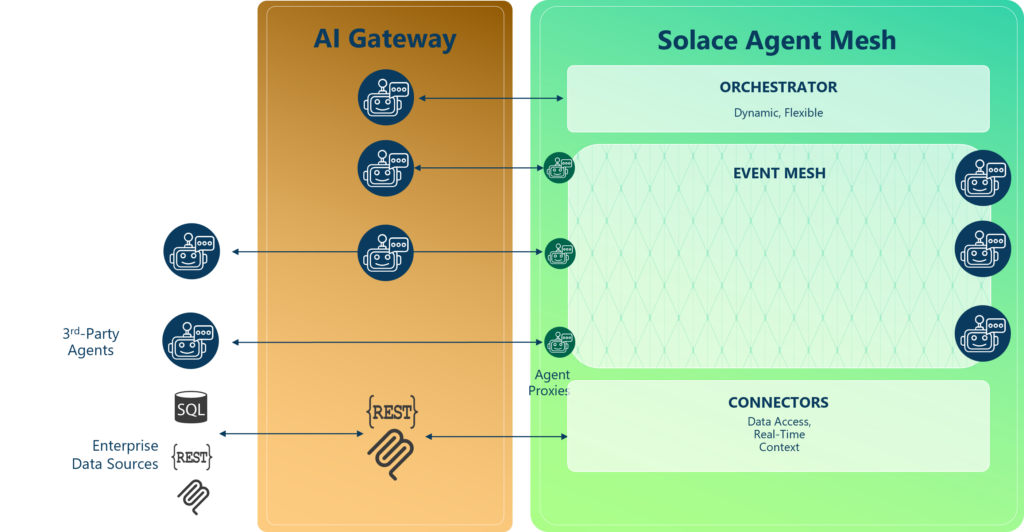
For simple, sequence-based tasks, agents managed through an AI governance layer can communicate directly point-to-point. This works well for prescriptive workflows where Agent A must always call Agent B to ensure a predictable outcome.
For more complex, dynamic workflows, Agent Mesh provides agent orchestration and introduces asynchronous mediation through an event mesh built with Solace Platform. Agents react to real-time event streams, allowing the system to scale naturally and absorb speed mismatches between different models and systems.
This enables organizations to build supervisor or manager agents in the AI gateway that aggregate multiple specialized agents through point-to-point connections. These composite agents can then be exposed to the wider Solace Agent Mesh for use in more dynamic orchestrations.
Identity Management and Authorization
- Enterprises need to put any applications under their single sign-on system
- Includes components of agentic AI: agents, MCP server, APIs
Identity management and security in agentic AI are centered on the Identity Provider (IdP). For an enterprise to maintain control, all components—including the AI agents, the tools they use, and the backend data systems—must be integrated under a unified Single Sign-On (SSO) framework.
Security is managed through a continuous chain of authorization that trickles down through the different layers of the system.
- Initial Authentication: The process begins when a user logs in and grants an agent permission to act on their behalf.
- Flow of Identity: This authorization must extend through every interaction. For example, if one agent calls another agent or a tool, the user’s identity and permissions must be maintained across that boundary.
- Accessing Data: Finally, when a tool interacts with a backend API to retrieve information, it must be authorized to do so while still respecting the original user’s security context.
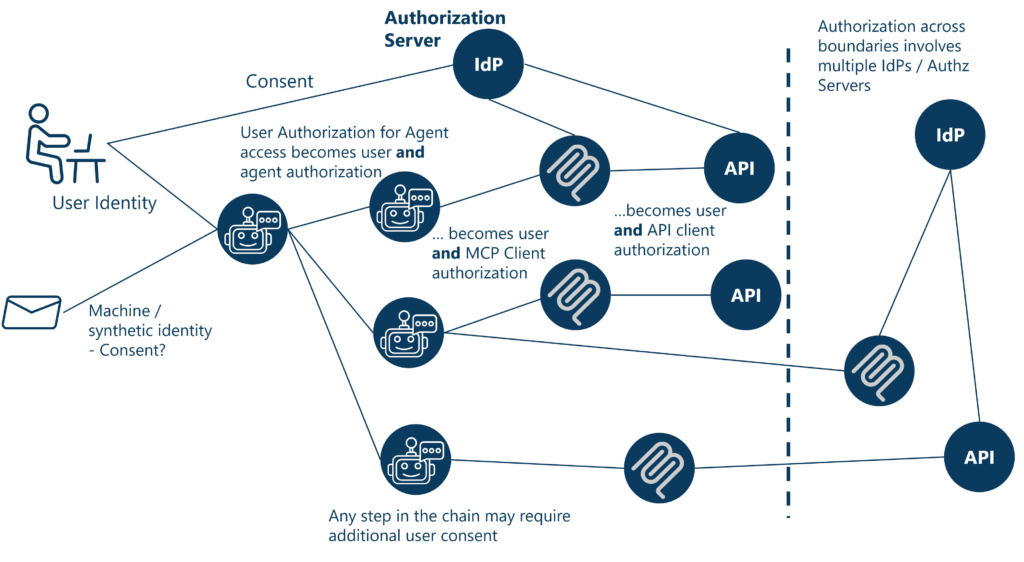
IdPs must address consent fatigue, which is caused by an agent requiring access to various external tools to complete a task and the user becoming overwhelmed by constant prompts to “allow” access for every sub-step. This is typically achieved using administrator-defined policies that automatically grant the necessary permissions.
Security becomes more complex when an agent needs to interact with tools or data outside of its own organization. In these cases, multiple IdPs and authorization servers must work together.
End-to-End Observability
The combination of Agent Mesh and AI governance—agent management, AI gateways—provides a unified “single pane of glass” for end-to-end observability. Agent Mesh’s Visualizer traces the lifecycle of a prompt or stimulus as it moves through the mesh, making agent interactions easy to understand.
At the same time, AI gateways add granular analytics and token tracking so administrators can monitor token use in real time, enforce token-based quotas to prevent bill shock, and route tasks to more cost-efficient models based on performance and spend insights.
Together, these capabilities ensure the agentic ecosystem is secure, orchestrated, and economically sustainable.
The Value of the Architecture for Agentic AI
Together, these two platforms give teams a governed and scalable foundation for running multi-agent systems in production:
- Accelerated Innovation: Teams can rapidly experiment by integrating native and third-party AI agents, reducing time-to-market for AI-driven applications by reusing existing API investments.
- Full Activity Observability: Administrators can visualize the full lifecycle of a request as it moves through the mesh. This makes it possible to follow the reasoning chain behind an agent’s decisions for greater trust and explainability.
- Predictable Scaling and ROI: The asynchronous backbone prevents system-wide failures and absorbs speed mismatches, while AI Gateway analytics give teams the insights needed to optimize costs and demonstrate the ROI of agentic workflows.
- Standardized Interoperability: Support for open protocols like A2A and MCP ensures the platform remains vendor-neutral, enabling organizations to coordinate agents across multiple LLM providers and cloud environments without lock-in.
Summary and Key Takeaways
The agentic enterprise succeeds or fails on its architecture. An agent mesh like our own Solace Agent Mesh delivers the asynchronous, event-driven backbone needed to orchestrate agents reliably at scale, while AI gateways and agent management provide the governance, security, visibility, and cost controls required for enterprise adoption. Identity management—with support for OAuth 2, OpenID Connect, and related standards—becomes the “single source of truth” for authentication and authorization for agents, tools, and backend APIs.
Together, they enable a regulated, interoperable agent ecosystem built on open standards such as A2A and MCP, avoiding vendor lock-in while ensuring trust, observability, and predictable economics. The result is a unified platform that transforms agentic AI from experimental capability into a secure, scalable, and outcome-driven enterprise capability.