
The modern airport is a complex ecosystem of multiple stakeholders, each making their own decisions, based on their own information, to meet their business objectives. Collectively those decisions determine whether an aircraft pushes back on time and whether a passenger makes a connection. Individually, not one of those organizations controls the outcome. Every one of them holds a fragment of the operational picture, and very few airports could honestly say that any single system, or any single team, has end-to-end control.
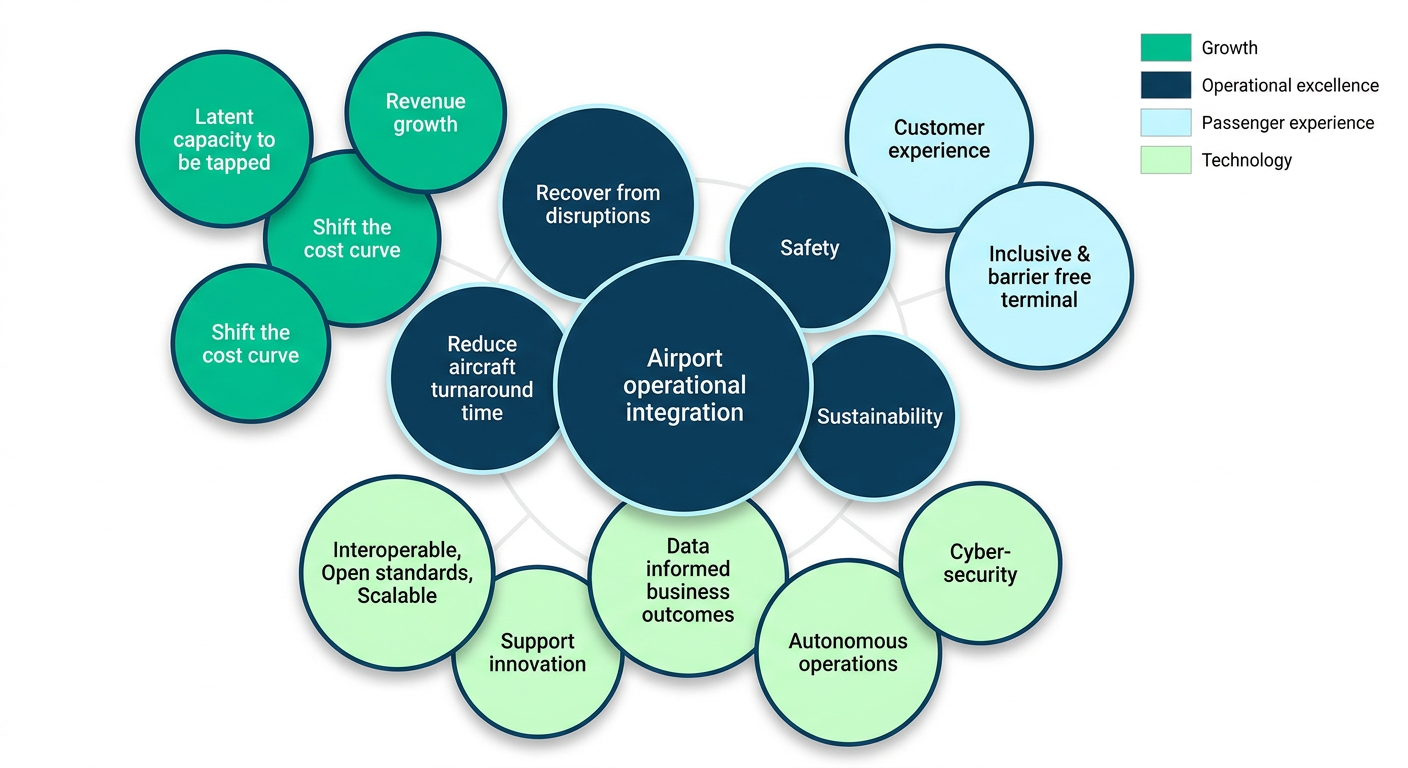
Key drivers for the airport.
An airport is an orchestration problem before it is an infrastructure one, and Asia-Pacific is where that distinction is about to matter most.
IATA projects that the region’s passenger numbers will double by 2043, growing at around 5.1 percent a year and comfortably outpacing Europe and North America. The infrastructure response is substantial – ACI expects airports across Asia-Pacific and the Middle East to invest some 240 billion US dollars over the next decade. Of that total, 136 billion is brownfield investment in airports that already exist, against 104 billion for entirely new ones. Most of the region’s additional capacity must come from airports that are already built, already operating, and unable to disrupt operations..
Meanwhile the constraint tightens. The number of slot-coordinated, capacity-constrained airports worldwide has risen from 170 in 2015 to 215 in 2025, and Asia-Pacific now ranks second only to Europe.
Yet whether an airport is expanding within existing infrastructure or building from scratch, the orchestration challenge is fundamentally the same. Both brownfield and greenfield operations depend on multiple stakeholders making independent decisions from fragmented information – and both struggle with the consequences.
Problems Facing Airports Today
Airports like other complex enterprises adopted automation early to support their business processes. This was followed by the phase of integrating the various automation systems to allow data sharing for meeting business objectives. A modern airport has individual systems exchanging data using modern interfaces in real-time.
For the next generation of the airport systems integration, the problem is not speed.
Pick an aircraft on stand this afternoon and ask five parties (out of the multiple collaborating stakeholders) when it will push back: the airline, the ground handler, the ramp team, the operations center, and the gate display the passenger is reading. In our experience you will get three to five different answers, all of them sincerely given, most of them produced by a system working exactly as designed.
The reason is that integration in most airports is built based on meeting data requirements between individual pairs of systems. The challenge is not transferring data but orchestrating various integrated applications into a unified ecosystem.
And people compensate manually. This is the symptom most worth looking for, because it is the easiest to miss. Radio calls to confirm what a screen already shows, data re-keyed from one system into another, shadow spreadsheets and chat groups running quietly alongside the official tooling. None of that exists because people are doing anything wrong – it is skilled staff doing the sensible thing in the circumstances. It exists because no single system view is trusted. It also costs the most when operations come under pressure, which is the moment errors are least recoverable.
The consequences are measurable. SITA’s 2026 Baggage IT Insights report puts the cost of baggage mishandling to the industry at 6.3 billion US dollars a year, 39% caused by coordination failures at transfer points where airports, ground handlers and airlines must exchange accurate and timely information.
The common thread is not that the data is slow. It is that stakeholders do not have a unified view of the data across the ecosystem. Airports have become so interconnected and complex that they struggle to make quality and timely decisions.
The Solution
The instinct, on recognizing this picture, is to commission another integration. Another interface, another point-to-point connection, another project to join two more systems together. That instinct is understandable, and is partially responsible for how the estate reached its current state.
The alternative is to stop moving data between systems and start publishing events once, to everyone.
DXC Technology brings more than forty years of master systems integration to this: knowing what the systems are, how they behave in practice rather than in the documentation, and how to deliver change into an operation that cannot be stopped for the weekend. Solace brings the event mesh – the layer that routes real-time events between distributed applications, connected devices and operational systems across cloud, on-premises and IoT environments.
Together they replace point-to-point integration with a single event backbone. A system publishes what happened once, at the moment it happened, in a form that any authorized consumer can subscribe to. One version of events, distributed to everyone who needs it, at the same time.
What is an event mesh?
An event is something that happened, recorded at the moment it happened. A bag was loaded. A stand was reassigned. An aircraft went on blocks. A security queue passed twelve minutes.
Traditionally, when one system needs to tell another system that something happened, somebody builds a connection between those two systems. With sixty or seventy systems, that becomes a great many connections, each of which has to be built, tested, secured and maintained — and each of which breaks when either end changes.
An event mesh turns that around. Rather than connecting systems to each other, every system connects once to a shared layer. It publishes the events it knows about, and it subscribes to the events it cares about. It does not need to know who else is listening, and whoever is listening does not need to know where the event came from.
The mesh is not a product you switch on. It is an architectural layer, assembled from event brokers deployed wherever your systems already live — in the terminal, in your data centre, at the edge next to OT equipment, and in whichever cloud you use. The practical consequence is that the eleventh system to need flight events costs a fraction of what the second one cost, because the events are already flowing.
Applications
Airport Collaborative Decision Making (A-CDM)
Turnaround milestones typically move by radio, telephone and bilateral feed, which means delay has usually propagated before every stakeholder can see it. On an event backbone, each milestone is published once and consumed simultaneously by the airport, the airline, the ground handler and the air navigation service provider. This is the foundation that Airport Collaborative Decision Making depends on, and the benefits are documented rather than theoretical: EUROCONTROL has measured average taxi-out savings of between 0.25 and 3 minutes per departure at A-CDM airports, alongside reduced fuel burn, better ground handling resource utilization and fewer late stand and gate changes. In Asia-Pacific, where ICAO established a regional A-CDM task force in 2016 and adoption is still building, the gap is better read as opportunity than as a deficiency.
Total Airport Management (TAM)
TAM is an extension and evolution of A-CDM. It takes a holistic approach to airport performance management by integrating operational processes across the airfield, terminal area and ground transportation center, consolidating data on flights, passengers and baggage, and involving stakeholders in a coherent planning and collaborative decision-making process. An event backbone is essential to the implementation of TAM to allow system wide information management. While this concept is beginning to only now penetrate the Asia-Pacific market, it is an essential element to unlock latent capacity in a constrained airport, improve efficiencies and enhance passenger experience. ACI Europe and ACI Asia-Pacific & Middle East are developing an inter-region TAM exchange program.
Airport Operations Center
APOC is a collaborative platform for key airport stakeholders enhancing decision-making, coordination, and operational efficiency through shared knowledge and a unified, coordinated approach. This collaboration requires an event backbone giving the stakeholders one live operational picture spanning terminals – flight, resource, passenger, baggage and ground handling on a shared stream – so that judgement gets spent on the decision rather than on working out what is true. Multiple airports have reported improvements of key indicators (OTP15, Operated schedules, etc.) after the implementation of the APOC as referenced in the Eurocontrol APOC Performance Study.
Autonomous Operations
Airports are embracing autonomous operations to improve efficiencies and reduce costs. This requires building a unified, high-quality, and real-time data foundation across disparate operational systems before deploying artificial intelligence or self-driving hardware. The event backbone streamlines the creation of this data foundation without impacting the operational data flow paths. This data foundation also supports the Machine Learning aspects of deploying AI agents at the Airport. In 2025, ACI Airport Insights survey indicated 93% of responding airports have an innovation strategy planned, including priorities for data, automation and connectivity.
Benefits
- Decisions get made earlier. When every party works from the same event stream, disruption is handled as it develops rather than after it has propagated through the day’s schedule.
- More throughput from infrastructure you already have. Coordination efficiency is the accessible lever at a capacity-constrained hub, and it is available on a timescale of programs rather than decades. Fully implementing A-CDM at capacity constrained London Heathrow increased declared capacity by one additional aircraft movement every two hours.
- Less manual compensation. As the shared picture becomes trustworthy, the radio calls, re-keying and shadow spreadsheets have less reason to exist. With them goes a category of delay and error that is rarely measured but reliably expensive.
- The cost per program falls. New consumers subscribe to events that are already flowing instead of triggering another integration project. The subsequent use cases cost materially less than the first, which is the opposite of how point-to-point estates behave.
- A foundation for what comes next. Real-time analytics, AI-assisted operations and data sharing with partners all depend on a live, trustworthy event stream. Building it once makes each of them tractable, rather than each of them being its own integration program.
Why DXC and Solace
The instinct, when facing airport complexity, is to commission another integration platform. But the problem isn’t the platform – it’s the architecture it’s built on. Point-to-point integration at scale creates fragility, cost, and the very delays you’re trying to solve.
DXC brings forty years of Master Systems Integration (MSI) experience earned in airports, not applied from a generic playbook. We’ve delivered transformation into live operations without stopping them. And we understand why airport integrations fail: not from technical limitations, but from treating airside, landside, passenger, and baggage systems as separate integration problems instead of one orchestration problem.
Solace brings the event broker architecture that makes unified orchestration tractable. But Solace alone is a technology choice. DXC + Solace together is an operating model change – one that replaces the integration project treadmill with a shared event backbone that gets cheaper to extend, not more expensive, with each new use case.
Proof at scale:
- Western Sydney International (Nancy Bird Walton): Selected as MSI, DXC designed and built the foundational technology platforms for a full-service, digitally enabled greenfield airport opening in 2026. We integrated 60+ IT and OT systems across passenger processing, baggage handling, security, and operations, with an event mesh built on Solace, enabling the airport to commence operational readiness and airport testing on schedule.
- Perth Airport New Terminal: Selected as MSI for Perth’s multi-billion-dollar terminal expansion, DXC is responsible for design, integration, testing and commissioning of 70+ IT and OT systems spanning passenger processing, baggage tracking, security screening, building management, digital signage and operational control.
Solace helps airlines, airports and ANSPs make air travel safer, more efficient and resilient by connecting aircraft, applications and operational systems with real-time data across a diverse ecosystem providing:
- Real-Time Operations: Connect flights, crews, gates, baggage and partners to respond faster to disruptions.
- Air Traffic Management: Power FAA and other SWIM environments by efficiently distributing flight, weather and surveillance data.
- Operational Efficiency: Improve fuel use, crew planning and turnaround times by connecting live data across systems and environments.
Getting Started
You do not need to begin with the whole estate, and we would advise against trying. Most airports we work with start with a single flow that several parties already argue about – turnaround milestones, or bag status, or stand allocation – and publish it properly once. That is usually enough to demonstrate the pattern, and it is small enough to be delivered inside a normal program cycle.
Whether you are a greenfield program, planning a new terminal, standing up an operations center, or modernizing an integration estate that has grown one project at a time, a conversation with the DXC and Solace aviation teams is the fastest way to work out what a shared event backbone would look like at your airport.