
Retail banking is entering a new era: Customers expect every interaction to be instant, personalised and always available, while regulators demand greater transparency and resilience. The sheer pace of technology developments such as artificial intelligence (AI), the cloud, and real-time data streaming have unlocked higher consumer expectations and a need for banks to roll out new capabilities quickly and accurately. Attempting this on a foundation of decades-old legacy tech estate can lead to high overheads, slow change delivery and unreliable solutions that leave customers underwhelmed. Continuing with current legacy architectural design is becoming unsustainable for retail banks. Many have gone some way to introduce pockets of real-time data for certain use cases, but few have a plan for how they will scale this across the enterprise.
The challenger banks that do not have this legacy constraint chose to largely build on an event-driven and cloud-first approach, as opposed to the batch-based monolithic systems that most incumbent banks are heavily reliant on. In short, this means that legacy banks are often operating on stale data, i.e. what happened yesterday, whereby challenger banks are geared up to react to events in the moment of the customer journey. The competitive advantage that this brings to the challenger banks is only going to get more significant in the months and years to come.
The changes we are seeing in the industry mean that this integration transformation is moving from a nicety to a necessity. With this post I’ll explain why retail banks need to rethink their infrastructure, how they can benefit by taking an event-driven approach, and how Solace can help. I’ll start by explaining the market forces that make change an imperative.
Why Traditional Banking Architecture Is Reaching Its Limits
Retail banking is facing five key challenges that mean banks must think differently about how they handle information and how data moves between their systems.
- Evolving customer expectations. In its Global Banking Annual Review 2025, McKinsey describes the “less loyal, more digital modern consumer, who expects hyper-personalized experiences and seamless, mobile-first integrated journeys”. Other industries that aren’t held back by decades of legacy system complexity are setting a high bar for this. Consumers know exactly where their taxi is, when their takeaway will arrive and how much electricity they are using in that moment. Yet when it comes to banking, they can wait for 10 days for a debit card without any confidence that it will ever arrive.
- Pressure from competition. Challenger banks built on cloud-native event-driven systems have a significant advantage. Being able to leverage streamlined, simplified architecture, they are creating more intuitive customer interactions and reducing complexity. Reduced complexity directly equals lower cost and improved time to market for new capabilities. Gartner’s analysis of the banking technology market points the same way, identifying operational agility, speed to market and customer experience as the initiatives now driving bank technology spend. (Source: Competitive Landscape: IT Service Providers, Banking and Investment Services)
- Regulatory Demands: Increasing regulatory demands require new integration between parties, i.e. Open Banking and PSD2. Where banks have a dependency on legacy systems and tightly coupled data pipelines, these new demands require large resource overhead and add to increasing architectural complexity. Most banks would acknowledge that far too much resource is currently consumed on regulatory requests that deliver minimal business value, while the desire to do more is being constrained. In the article Modernizing Legacy Systems in Banking, Deloitte identifies legacy core systems as a direct source of regulatory compliance and internal controls risk for banks.
- Agentic AI: The hype around AI is quickly becoming reality and the realisation of the need to scale AI agents into the thousands is causing architectural challenges in industries all over the world. Gartner puts the bottleneck squarely on the estate rather than the models, warning that “integrating agents into legacy systems can be technically complex, often disrupting workflows and requiring costly modifications”. They also predict that by 2028, at least 15% of day-to-day work decisions will be made autonomously through agentic AI, up from 0% in 2024. (Source: Gartner Predicts Over 40% of Agentic AI Projects Will Be Canceled by End of 2027, 25 June 2025)
- Data Explosion: The significant changes to social behavior over the last couple of decades have driven exponential growth in digital activity. Humans are creating far more data than ever before and, in many cases, traditional systems are struggling to cope with this increased load. For example, as consumers make more and more ‘micro payments’ non-cash transaction volume was on track to hit 1.65 trillion, according to CapGemini’s World Payments Report 2026, representing a tenfold increase in less than 20 years.
The Scalable Solution for Real-Time Data: Event-Driven Architecture
Solace technology is predicated on event-driven architecture (EDA) whereby systems emit events when state changes occur, and other systems subscribe and react in the moment. Events can be anything from a customer logging into mobile banking to a loan application being approved. Communication between publishing systems and subscribing systems is managed through an event broker, enabling multiple systems to subscribe to the same events, receiving updates at the same time, as they happen. The technology acts as a central nervous system for enterprise businesses, allowing them to connect everything and operate in real-time.
Scalability and Reduced Time to Market
EDA means a system can stream an event to a broker as it happens, and multiple other systems, including AI agents, can react to that event in real-time. The connection between the source of the event and the broker is decoupled from the systems / agents reacting to it. Therefore changes to source systems can take place without impacting subscribing systems.
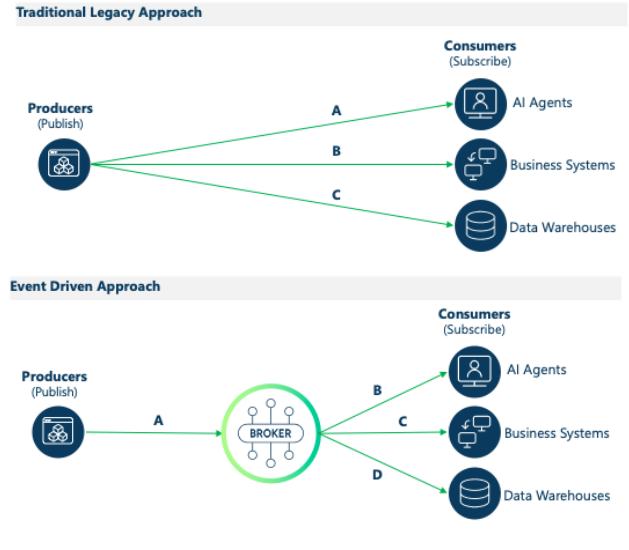
For example, with EDA if you change path A from the publisher to the broker, paths B, C and D to subscribers would continue to receive events in the exact same way. Conversely, in the legacy point-to-point approach, changing something about the publisher would require you to re-work all paths to individual subscribers.
This is a very simple example; there could be thousands of AI agents reacting to the events, which just cannot scale in the traditional approach to connecting systems.
How Retail Banks Benefit from Event-Driven Architecture
Common high-priority business performance metrics that this will help to drive include:
- Net Interest Margin (NIM): Deposit repricing lag reduction and improved retention with rate matching
- Cost to Income Ratio: Reduced tech spend on development due to lower complexity, incremental legacy decommisioning.
- Net Promoter Score (NPS): Delight customers with intuitive initiatives, and reduce incidents that create negative sentiment
- Straight Through Processing (STP) Rate: Legacy batch processes often require manual intervention at batch boundaries
While there are many benefits, and some quite specific to niche use cases, there are three overarching benefits that EDA provides:
- Real-Time Data: Faster
- Reduced complexity: Simpler
- Greater resilience: Safer
Real-Time Data
EDA processes “data in motion,” enabling action before data loses value. The measurable impact of this can be reduced fraud losses, improved customer trust, increased journey automation and increased product fulfilment. At Solace, real-time means right now, not in a few minutes, not even in a few seconds. Event transfer is measured in microseconds, and brokers can handle millions of events per second.
Where data transfer is time-critical, Solace Platform is a popular choice. This is why it has played a fundamental role in the architecture of investment banking for the last few decades and now the same real-time technology is becoming increasingly relevant to retail banking, supporting use cases such as:
- Real-time fraud detection
- In the moment marketing initiatives
- Dynamic pricing
Improved Agility and Faster Time to Market
Traditional banking systems are typically reliant on point-to-point integration, which makes changes risky and time-consuming. EDA is a modular approach – adding a broker between systems that produce events and consumers of those events. Unlike the 1:1 relationship in point-to-point architecture, this enables 1-to-many relationships between producing systems and subscribers. Databases, business systems and AI agents can all react to the producing system in real time.
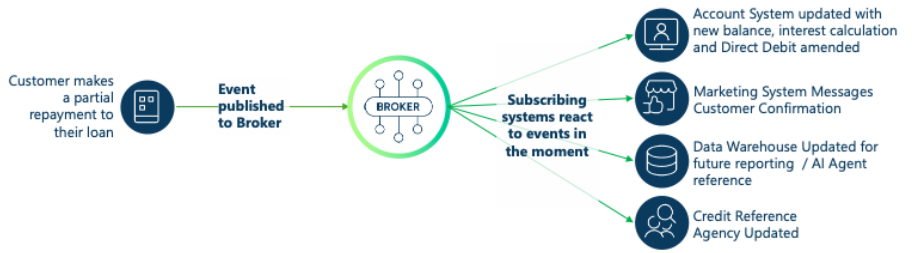
If you were to make a change to the producing system in an event-driven system, you would only need to maintain the connection between the publishing system and the event broker. The connections to any consuming systems would all continue to receive the events regardless of any changes to how they originate.
Some advantages of this agility in retail banking:
- Better compliance with regulatory requirements such as PSD2 and Open Banking: Supports banks meeting regulator time scales and minimises the disruption these requests often have on delivering other business objectives.
- Reduced Time to Market: Enables Banks to delight customers with continuous innovation as well as reducing costs by less coordination demand for technical and engineering resources.
- Faster incident resolution: Inevitably things go wrong from time to time—a decoupled and more simplified architecture minimizes reputational and financial impact of incidents by reducing average time to resolution and the cascade impact of failures.
Greater Resilience
We are now in a world where every customer interaction is powered by technology, often multiple systems operating alongside one another to provide a service to customers. As technology stacks and the demand on them continues to grow, so do points of failure, and so does the number of incidents. Banks must remain operational when applications, infrastructure, or entire environments experience disruption.
Systems built with EDA in mind with solutions such as Solace Platform enhance resilience by intelligently routing events across systems, eliminating single points of failure and reducing dependencies between applications. With features such as guaranteed delivery, automatic failover and event replay capabilities, critical business events continue to flow during outages and can be recovered without data loss. This means faster resolution of incidents and much lower disruption to customers.
The same principle applies to planned maintenance; systems can be updated ‘in-service’ without impacting other systems that are dependent on them and downtime is much lower. In summary this approach can dramatically reduce the impact on customers and the resources required for incident resolution. Focus on innovating tomorrow’s architecture rather than fixing yesterday’s.
The Cost of Standing Still
For many incumbent banks, maintaining the status quo can feel like the safest option. Existing systems continue to operate to a satisfactory standard, regulatory obligations are met and change programs continue to be seen as costly and high risk. However, the greatest risk may no longer be the change itself but the impact of choosing not to change.
| Standing Still | Investing in the Future | |
|---|---|---|
| Time to Market | Months to deliver change, missed opportunities and decreasing relevance | Release change in days, seize opportunities and stay ahead |
| Operating Costs | Higher operational cost to run, integrate and to maintain complex systems | Lower operational cost through simplified architecture and increased efficiency |
| Risk | Fragile integrations, manual process and siloed data increase operational and compliance risk | Resilient modular decoupled systems improve stability, security and compliance |
| Customer Experience | Delayed, inconsistent and fragmented customer experiences erode loyalty | Real-time, personalised experiences drive advocacy, loyalty and growth |
| Innovation | Legacy architectures make it harder and slower to adopt new technologies such as AI | Real-time data and AI ready foundations unlock new products and services |
Every year that banks continue to rely on legacy batch-driven architecture, the gap between them and digital-first competitors widens. What was once considered acceptable service has become poor customer experience. This shows up as delayed notifications, overnight processing, fragmented customer journeys and inconsistent data presented across systems. Banks are no longer just compared with each other, they are compared with the instant personalised experiences consumers receive from companies such as Amazon, Uber and Netflix.
The financial impact extends well beyond customer satisfaction. Legacy architectures increase operational costs through duplicated integrations, complex maintenance, manual intervention and lengthy testing cycles. Technology teams spend a disproportionate amount of time maintaining existing systems rather than delivering innovation. McKinsey has repeatedly identified legacy technology as one of the biggest barriers to digital transformation within banking.
Closing Thoughts
Twenty years ago, things like paper-based processes, waiting 5 days for payments to come through, and posting cheques off to a centralised processing centre were all considered normal and acceptable processes. With the benefit of hindsight, that had to change.
We will look back on this as the moment before AI became the primary interface between customers and their financial services — the moment before banks levelled up to meet the standards set by other industries.
Banks that modernise their integration between systems today will be best positioned to scale AI. Those that don’t are likely to find that their greatest barrier to AI success isn’t the model itself – it’s the architecture sitting beneath it.
The good news is that this change can happen gradually. Changing integration approach doesn’t mean ripping up and starting again, it can be implemented on an individual use case or user journey basis and grow organically over time across the bank.
You can get a general idea of what that takes by reading our whitepaper The Architect’s Guide to Implementing EDA and I’ll provide retail banking specific guidance soon!
Explore other posts from category: Financial Services




Subscribe to Our Blog
Get the latest trends, solutions, and insights into the event-driven future every week.