
Introduction to ADLC
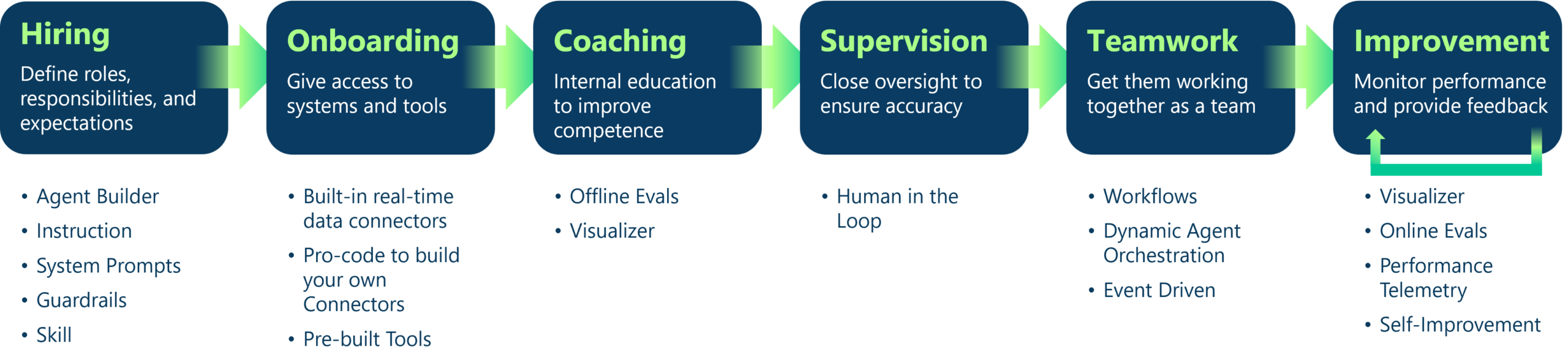
- Hiring — Define role, responsibilities, expectations
- Onboarding — Give access to systems and tools
- Coaching — Internal education to improve competence
- Supervision — Close oversight to ensure accuracy
- Teamwork — Get them working together as a team
- Improvement — Monitor performance and provide feedback
Hiring
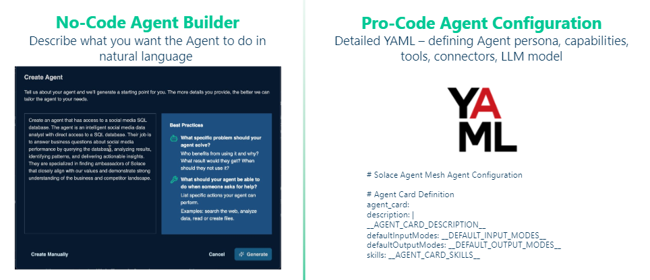
Start with a job description, not a prompt
Describe what the agent is for in plain language and the builder generates a working starting point. Or write the YAML yourself — persona, skills, tools, model. Guardrails define what it can’t do before it ever speaks to a user.
- Describe the role in natural language and generate a starting config
- Configure persona, skills, and tools in YAML
- Constrain behaviour with explicit guardrails
Learn More
→ Docs: What is an agent
Onboarding
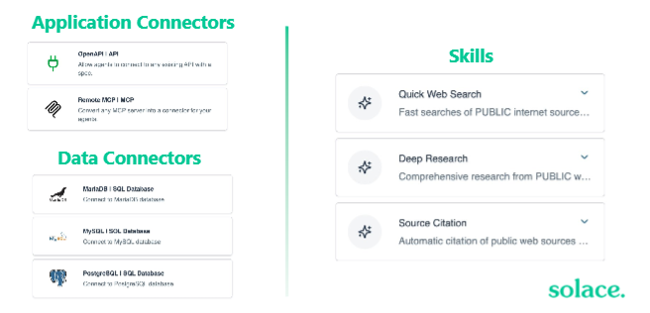
The access they need, and nothing more
First-day provisioning for a software worker. Pre-built connectors reach SQL databases, APIs, and MCP servers. RBAC, SSO, and delegated identity decide what each agent can touch and on whose behalf it acts.
- Connect SQL databases, APIs, MCP servers, and A2A agents
- Govern access with RBAC, SSO, and delegated identity
- Extend with your own connectors, tools, and skills
Learn More
What is an Agent Mesh entrypoint?
Aboout role-based access controls in Agent Mesh
Coaching
Gate the release on the eval score
Prove competence before production. Build datasets of prompts and expected responses, score them with rule-based evaluators or LLM-as-a-judge, and run experiments from the CLI or the UI. sam eval run polls to completion and fails when the pass rate drops below your threshold.
- Score with rule-based evaluators or LLM-as-a-judge
- Run experiments from the CLI or the Agent Mesh UI
- Fail the pipeline when the pass rate drops below threshold
Learn More
→ Evaluating agent performance in Agent Mesh
Supervision
Oversight calibrated to the stakes
Human-in-the-loop will route high-value or low-confidence actions to a reviewer for approval before execution, so agents can be deployed into high-stakes workflows while trust is still being earned — and the threshold relaxed as it is.
- Route high-stakes actions to a human reviewer
- Escalate automatically on low confidence
- Relax the threshold as the agent earns trust
Teamwork
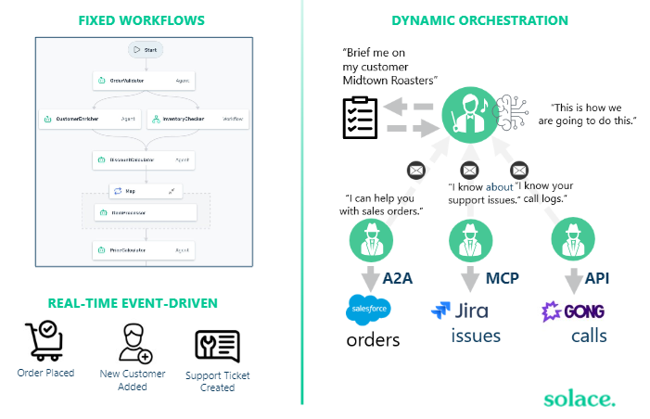
Two coordination models, one platform
Deterministic workflows when the sequence is known and auditability matters. Dynamic orchestration when the plan has to be decided at runtime. Agents talk asynchronously over the event broker rather than synchronous API calls, so one slow agent doesn’t stall the mesh.
- Define deterministic workflows as a DAG
- Delegate at runtime via orchestrator agents
- Communicate asynchronously over A2A on the event mesh
→ Docs: Agent-to-Agent protocol docs.solace.com/Agent-Mesh/Framework/concepts/a2a-protocol.htm
→ Docs: The event-driven mesh docs.solace.com/Agent-Mesh/Framework/concepts/event-driven-mesh.htm
Improvement
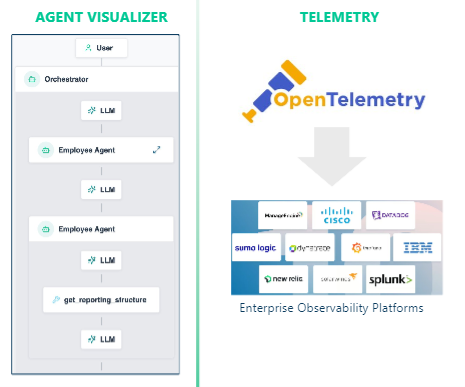
One trace ID, from end to end
Every task carries an immutable trace ID minted at the entrypoint and forwarded through agent, tool, and peer delegation — one query returns the whole causal chain. Metrics export over OTLP to the stack you already run. Every authentication, RBAC decision, and tool execution lands in an audit record.
- Correlate every hop on one immutable traceID
- Export OpenTelemetry metrics to Datadog, Grafana, New Relic
- Audit every authentication, RBAC decision, and tool execution
Learn More
→ Monitoring your Agent Mesh
→ Managing audit and compliance
Related Resources
Three cards: the whitepaper (Managing AI Agents at Scale), the blog post (treat your agents like employees), and the Agent Mesh docs overview.
- Whitepaper: Managing AI Agents at Scale: The Agent Development Lifecycle
- Blog Post: Want Agentic AI to Work? Treat Your Agents Like Employees
- Documentation: Solace Agent Mesh
FAQ
What is the agent development lifecycle?
Most vendors and analysts define the agent development lifecycle (ADLC) as the structured, end-to-end process for designing, building, testing, deploying, and continuously improving AI agents in production. It’s treated as the agent-era counterpart to the software development lifecycle (SDLC): traditional SDLC assumes static, deterministic systems, but an agent’s outputs shift with prompt changes, model updates, and new data, often without any code release. That volatility is why most descriptions frame the ADLC as a loop rather than a one-way pipeline, with monitoring and evaluation results feeding back into the build stage instead of ending at launch. Phase names vary by vendor, but they converge on the same shape: define scope, build and test against evaluation criteria, deploy with guardrails, then monitor and refine.
How is the ADLC different from the SDLC?
The SDLC assumes the software you ship stays the same until the next release: write the code, test it, deploy it, and move on. The ADLC can’t make that assumption, because an agent’s behavior shifts with every prompt change, model update, or new class of user request, often without any code change at all. That’s why the ADLC treats evaluation, guardrails, human oversight, and tracing as ongoing disciplines rather than a one-time gate before launch.
Do I need Agent Mesh to implement the ADLC?
No. The ADLC is a way of thinking about agent development, not a product, and you can apply its discipline with any combination of tools. Agent Mesh exists to make that discipline practical: a builder and guardrails for hiring, RBAC and connectors for onboarding, evaluation pipelines for coaching, human-in-the-loop routing for supervision, orchestration for teamwork, and tracing for improvement, all in one platform instead of six separate systems you have to wire together yourself.
Which LLMs and clouds does Agent Mesh support?
Any LLM and any cloud. Agent Mesh connects directly to model providers including OpenAI, Anthropic, and Google, and to hosted models through AWS Bedrock, Azure OpenAI, and Google Vertex AI, so model choice can follow your existing procurement, compliance, or data-residency requirements instead of a platform limitation. The mesh itself runs on any cloud, on-prem, or at the edge.
Can I use it alongside LangGraph, Bedrock AgentCore, or Azure AI?
Yes. Agent Mesh supports the open Agent2Agent (A2A) and Model Context Protocol (MCP) standards, so agents built on LangGraph, Bedrock AgentCore, Azure AI, or custom code can register as peer agents and participate in the mesh without a rewrite. A LangGraph agent, for example, can be exposed as an A2A endpoint that the Agent Mesh proxy routes tasks to like any other agent, so existing framework investments join the ADLC instead of being replaced by it.
Next Steps
Ready to put your agents to work?
- Book a demo
- Download Agent Mesh and start building agents