Breaking Data Gravity with New CDC Micro-Integrations
Every enterprise architect and developer knows the importance, and challenges, of turning static data into a continuous data flow.

Your transactional systems create the data and then legacy databases and data lakes excel at handling persistence, but they act like high-mass celestial bodies—trapping valuable event data deep within their silos. But they are critically important for the role they serve as sources or targets of operational real-time data.
When downstream applications, real-time microservices, or AI models need that data, they are often forced to wait for scheduled, resource-heavy overnight batch jobs or complex, fragile ETL pipelines. This latency creates a massive data lag but also introduces data friction. A sale occurs, an inventory item updates, or a customer shifts preference, but your modern analytics engines and real-time dashboards don’t find out until hours later.
To build a truly reactive enterprise, you need to liberate data at the source as it happens or use the change capture to trigger the streaming on the event payload that matters and not the entire object. This is ideally done without adding operational overhead to production systems.
What are Micro-Integrations?
To solve this, a structural shift is needed in how we handle connectivity. If microservices revolutionized application architecture by decomposing monoliths into nimble, single-purpose components, micro-integrations do the exact same thing for the integration layer.
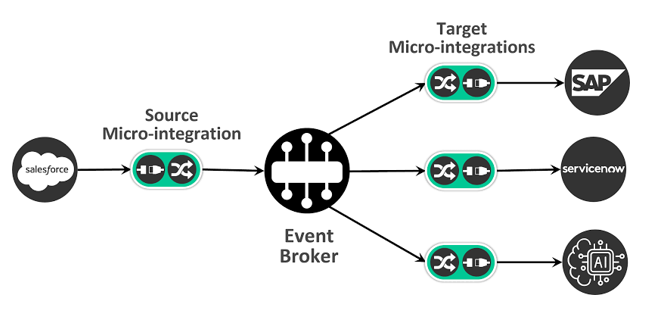
Instead of relying on a centralized, heavy Integration Platform as a Service (iPaaS) that creates network bottlenecks and requires complex transformation code, a micro-integration acts as a small, containerized, edge-deployed unit. It does one specific job: it establishes data movement between an external system and the Solace event mesh.
- Source Micro-Integrations: Ingest data by listening to an external system and streaming changes onto the event mesh as real-time events.
- Target Micro-Integrations: Egress data by taking events from the mesh and securely writing or updating them into target destinations.
Because these units are completely decoupled from each other, they can be deployed in close proximity to the data source (reducing firewall and NAT complexities), scaled out horizontally, and modified independently without interrupting the rest of the integration ecosystem.
The New Blueprint: Database Micro-Integrations
Solace has expanded its integration library to bring native, event-driven streaming to your core data stores. By utilizing high-performance Change Data Capture (CDC) these micro-integrations automatically turn row-level inserts, updates, and deletes into lightweight events on your mesh. This enables data streaming of the raw data and via edge transformations into the precise data needed by the target applications.
Here is a breakdown of the latest database micro-integrations, engineered for both self-managed environments and fully cloud-managed deployment through the Solace Cloud Console:
PostgreSQL – Bulk table Database CDC Source | Self and Cloud Managed
MS SQL Server – Bulk table Database CDC Source | Self and Cloud Managed
MySQL – Bulk table Database CDC Source | Self and Cloud Managed
IBM DB2 – Bulk table Database CDCSource | Self and Cloud Managed
Oracle – Bulk table Database CDCSource | Self and Cloud Managed
MongoDB – Bulk table Database CDCSource | Self and Cloud Managed