OpenTelemetry Observability in Solace Agent Mesh
Visibility into your agentic operations
We are thrilled to announce that the enterprise edition of Solace Agent Mesh now features OpenTelemetry (OTel) observability to enable advanced token and context governance. This adds an important OpenTelemetry-based observability pillar to the agent visualizer already native to the platform.
By pairing enterprise-grade, real-time ecosystem telemetry that enables granular cost control, we are giving enterprises the infrastructure required to scale production-grade AI safely, predictably, and cost-effectively.
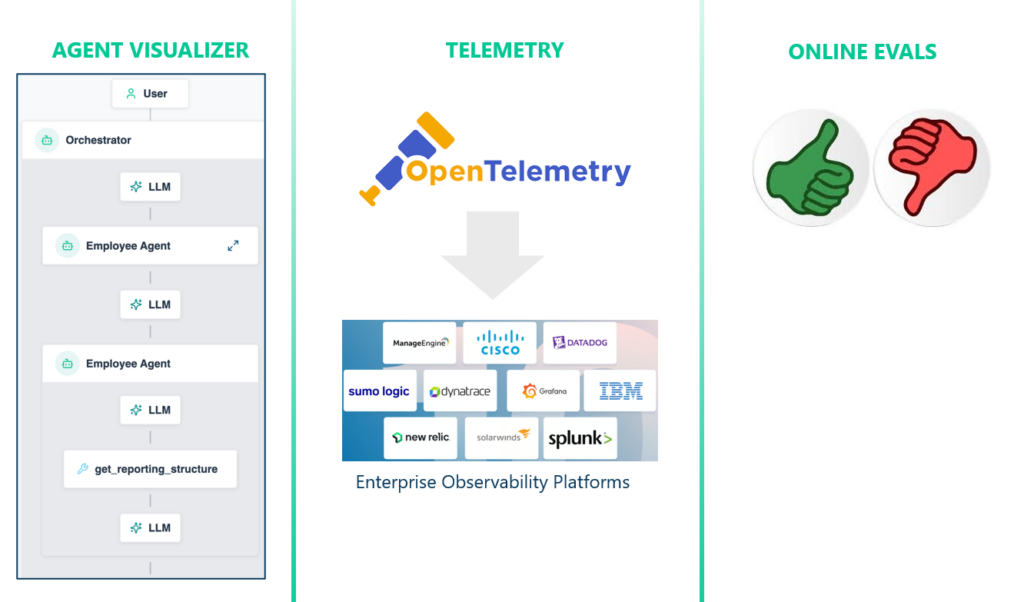
Observability in Solace Agent Mesh
Logging Isn’t Enough
In an enterprise environment, an AI agent does not exist in a vacuum. It relies on a sprawling ecosystem: LLMs, vector (and other) databases, API gateways, custom integration connectors, and the underlying event brokers that tie them all together.
With native OpenTelemetry support, Solace Agent Mesh Enterprise now exposes a rich set of real-time metrics via a Prometheus-compatible endpoint. This data can be seamlessly exported through the OTel Collector straight into your existing observability stack—whether your organization standardizes on Datadog, Grafana, Prometheus, or any other OTel-compliant backend.

- Agent Health & Status: Real-time up/down/degraded status gauges across every single agent in your mesh.
- System Performance Histograms: Latency tracking across P50, P95, and P99 percentiles to instantly pinpoint where delays are being introduced.
- Dependency & Gateway Reliability: Comprehensive tracking of outbound request latencies with explicit service and operation labels for all connectors and database integrations.
- Unified OTel Logging: Consolidated access to system logs via the OTel logs endpoint, allowing teams to correlate metrics and logs within a single pane of glass.
The Economics of Context: Token Governance and Optimization
Operational uptime is only half the battle; economic sustainability is the other. In agentic frameworks, the context window is a precious and expensive resource. As agents engage in longer, more complex multi-turn dialogues, managing token consumption becomes paramount to preventing runaway cloud spend.
Datadog visualization of token usage for agents in an enterprise
To address this, this latest release introduces a comprehensive and integrated Token and Context Governance framework. This layer brings complete transparency to AI interactions by breaking down usage by model and task. This enables both the OpenTelemetry endpoint, like Datadog, Grafana, Prometheus, but also token governance with cost indicators and the ability to forecast budget. This delivers several strategically valuable things to the enterprise:
- Real-Time Cost Awareness: Users and systems gain continuous visibility into context consumption via persistent metrics—including percentage of context window used, precise token counts, and estimated financial costs—mirroring the proactive feedback loops found in modern IDE assistants.
- User-Controlled Context Optimization: When conversations approach context thresholds, users can leverage manual context compression algorithms. This strategically reduces token footprints, extending conversational sessions and driving-down costs without sacrificing critical historical data.
- Granular Enterprise Cost Governance: For administrators, you get access to usage analytics. By dissecting prompt tokens, completion tokens, and model-specific metrics, leaders can identify high-consumption patterns, accurately forecast AI budgets, and optimize resource allocation.
A Scalable Foundation for Autonomous Operations
This dual focus establishes the ideal foundation for the future of enterprise AI. By observing how your agents degrade, how your connectors perform, and how your context is consumed in real time, you can confidently architect automated context management policies and intelligent workflows.