
Picture a machine on the shop floor. An operator asks an agent: “Something seems wrong with CNC machine XYZ. Is it serious?” The agent lists the available event types and finds machine.sensor.reading.v1. It subscribes for machine XYZ, collects 60 seconds of readings and compares them with the ranges in the operating manual. Then it answers: “Vibration on the spindle sensor is rising and still in range. Not critical yet.”A language model answers when it is asked. It cannot wait for something to happen, and nothing can call it back, so the listening in this example has to come from somewhere else. Most of what an agent does today starts with a request, from a user or from a timer that somebody set up.
MCP Events standardizes the other direction: a server tells an agent that something happened. The specification was accepted on 11 November 2026 and ChatGPT already ships a part of it. Most of what has been written about it so far explains it to people who build MCP servers and webhooks. We build event brokers, so we read it as a broker vendor does: what does the server need behind it to keep what it promises?
| MCP Events at a Glance | |
|---|---|
| Specification | An extension to the Model Context Protocol (SEP-3415). Accepted on 11 November 2026, status Final. |
| Delivery | Over HTTP: poll, stream (server-sent events) or webhook. |
| What it adds | Event discovery, filtered subscriptions, resuming after a disconnect, and secured webhooks. |
| Guarantee | At-least-once when the server has a durable source. The client deduplicates. |
| Driven by | AWS, Microsoft, Anthropic and OpenAI, in the Tasks and Events working group. |
| In production | ChatGPT, in webhook mode, since September 2026. |
| Not covered | Bindings for message queues, and how an event reaches the model. |
How do Agents use Events?
The machine example is the first of the two: an agent is already working on a request and has to listen for a while, all inside one task.
The second way starts without a request. An order runs into an exception, an incident is opened or a payment fails. Nobody has asked for anything, and an agent should start working on it all the same. In this case the event starts the run. Which event starts which agent, and with which instruction, has to be settled before any model is involved. That is a topic of its own, and the third post in this series will cover it.
A few platforms already let an event start an agent, for example through event triggers in Microsoft Copilot Studio or Claude Code routines. Each works inside its own product, with the event sources its vendor has connected. MCP’s own resource notifications need a live connection and cannot be resumed after a disconnect.
None of these lets any server offer its events to any agent.
What is MCP Events?
MCP Events is an extension to the Model Context Protocol, specified in SEP-3415. It delivers events over the three HTTP patterns that agents and their frameworks already use. The table compares them with with MCP Tasks, MCP’s own extension for long-running asynchronous requests, and A2A, the protocol agents use to delegate work to one another.
| Pattern | MCP Events | MCP Tasks | A2A |
|---|---|---|---|
| Poll The client asks what happened since its cursor. | events/poll | tasks/get | GetTask |
| Stream The server answers with server-sent events on a long-lived response. | events/stream | notifications/tasks on a stream | SendStreamingMessage |
| Webhook The server posts events to the client's HTTPS callback URL. | events/subscribe | not specified | CreateTaskPushNotificationConfig |
The two columns on the right show the same patterns in the neighboring protocols.
No delivery mode is mandatory. A server says per event type which ones it supports.
On top of the delivery modes the extension defines the parts that every home-grown webhook integration ends up building again:
- Discovery. Events/list returns the event types a server offers, each with a schema for the payload and one for the subscription arguments.
- Subscriptions with typed arguments. The client asks for priority 1 incidents of one service, and the server does the filtering.
- A cursor that the client owns. After a disconnect the client presents its last cursor. The server replays what was missed, or says that it no longer can.
- Leases on webhook subscriptions. The server grants a subscription until a point in time (refreshBefore) and the client has to renew it. An agent that disappears stops receiving events without anybody cleaning up after it.
- Signed and verified callbacks. Webhook delivery is a profile of Standard Webhooks, and the server verifies the endpoint before it delivers anything.
- Authorization on every request.
- Small payloads. An event carries enough to identify and triage it, and the agent fetches the rest through the server’s tools. That keeps personal data out of logs and queues, and it leaves a prompt injection less room.
If you build MCP servers and want the full walk-through, the official overview is the place to go.
What Sits Behind the MCP Events Server
The client sees HTTP. Where the server gets its events from is not in the specification. It can be an event broker, a log or a database table.
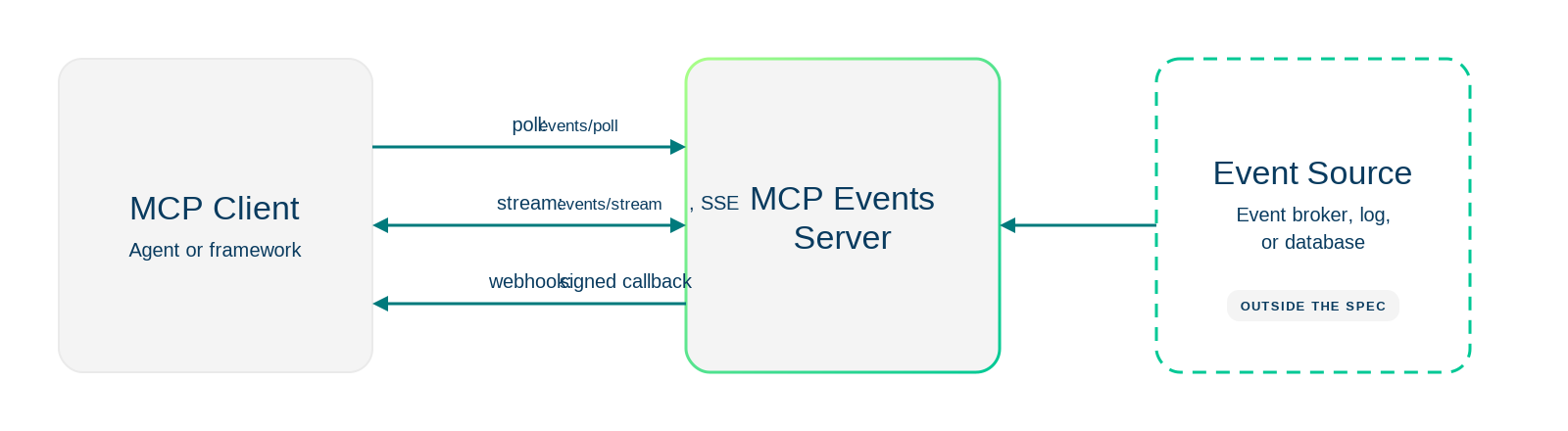
Now look at what the server has promised. A client comes back after an hour offline, presents a cursor, and expects the events it missed. No event may get lost between the source and the HTTP response, also when the server process restarts in between. Many subscribers with different arguments each get only what they asked for, in order within their subscription.
Something has to keep these promises. For a server that reports changes from its own database, a table with a sequence number will do. It looks different for events that already flow through a company, such as order events from an ERP system or sensor data from a plant. There, persistence, replay from a position, filtering by subscription and ordered delivery are what an event broker does all day. An MCP Events server in front of a broker can leave the hard parts to it. The server translates subscription arguments and cursors into what the broker already offers, and speaks HTTP to the agent.
What MCP Events Decides and What It Defers
The extension makes a few deliberate choices and leaves some topics for a later revision. We think it drew the line in the right place.
- HTTP first. Bindings for MQTT, Kafka, SQS or Google Pub/Sub are out of scope for this revision. That fits the history. SOAP, REST, webhooks, and now MCP and A2A—every wave that reached application developers ran over HTTP. The messaging protocols were always there, in the infrastructure layer, where most developers never saw them. Event-driven is a pattern (technically a superset of many patterns…) and it reaches developers over the protocol they already use. Every agent framework has an HTTP client, and few have a broker client. A2A went the other way and defines how to bind the protocol to other transports. MCP Events does not concern itself with native event protocols.
- Delivery is at-least-once, and the client deduplicates. Every event carries an eventId, and a client that sees the same one twice drops it. This is the correct design. Over a channel that can lose messages, the sender cannot know whether its last message or the acknowledgment for it arrived. It sends again and risks a duplicate, or it does not and risks a loss. At-least-once with deduplication on the receiver is what an honest protocol offers, and we would be suspicious of one that promised more. The guarantee has a condition: the server needs a durable source behind its cursor, which is the subject of the section above. Event types that are only emitted and not stored can be lost when the server restarts.
- Ordering is scoped to one subscription. Within one subscription, poll and stream deliver in the order the server produced the events. For webhooks the order is best effort, and across subscriptions nothing is guaranteed. Replay from a cursor is optional per event type.
- What happens after delivery is the agent framework’s job. Somebody has to hold the subscription, renew the lease, keep the cursor and turn an arriving event into a model call. The SEP calls this an application-level concern and does not prescribe it.
What’s the Status of MCP Events?
The work happens in the Tasks and Events working group of the MCP project. It was chartered in March 2026 as the Triggers and Events working group and took over Tasks in October. The extension is driven by AWS, Microsoft, Anthropic and OpenAI. On the eventing side, the webhook platform vendors take part. The group is open and meets every week, and we have joined it to add the view from the event broker.
SEP-3415 was opened on 5 October 2026, accepted on 11 November and has since been marked Final. The extension is published as Beta in the ext-events repository. No official SDK has released support yet; implementations for TypeScript and Python are in open pull requests.
It is also in production. ChatGPT was the first assistant to support MCP Events. It has done so since 29 September 2026, in webhook mode: a plugin’s MCP server can start an automation when something changes in the connected app.
What is Solace Doing to Support MCP Events?
We have a working prototype of an MCP Events server that sits in front of a Solace Event Broker and exposes its events to agents. We have also connected our prototype to ChatGPT, and that is the subject of the next post in this series. The one after that follows a business event until it starts an agent run.
Explore other posts from category: Artificial Intelligence




Subscribe to Our Blog
Get the latest trends, solutions, and insights into the event-driven future every week.