
AI agents change that. They reason and act on their own, at machine speed. The human bottleneck that made slow data tolerable is gone – now the data itself is the constraint, and anything that moves slowly or in batches becomes the weak link.
Real-time data is the missing ingredient for agentic AI — and exactly the problem we solve. It’s why Solace exists: one platform that connects every application, cloud, partner, and edge device, and powers agentic AI in production.
Every framework claims connectivity and context are baked in, but behind the scenes, the data interactions are a mess.
Think Event-Driven
Real-time data is only possible when you design around event-driven architecture (EDA), which is what we’ve been doing since our humble beginnings, and why we kick off new customer engagements with a “Think Event-Driven” workshop that helps them rethink how their backend is built.
A customer placing an order, a payment clearing, a sensor reading, a price change, a shipment scanned at a dock, an agent finishing a task and handing off to the next – all events.
These aren’t hypotheticals:
- Bosch synchronizes production data across its global plants for faster response to anomalies.
- Danone links more than 100 factories and 300 distribution centers in real-time for predictive, AI-driven operations.
- HORNBACH pushes pricing, product, and transaction events across 170-plus DIY stores in near real time, replacing batch and file-based updates.
- PSA Singapore streams container moves and equipment diagnostics across Tuas, the world’s largest automated port.
The Hard Part Nobody Shows You
Design your systems to react the moment something happens, and real-time stops being a feature you bolt on — it becomes the natural state of the business.
And that is exactly what agentic AI demands. Agents act on what’s true right now, and expect the rest of the enterprise to keep up.
Once you get past the demos, you’ll find that building one agent is easy, but feeding thousands of them the right data at the right moment — without drowning them in noise or stranding them on a call that never comes — is the hard part.
This is where most agentic projects quietly fail. Most proofs-of-concept never reach production, and only a fraction of enterprises see real value. The models aren’t the problem, and neither are the frameworks. It’s the data layer underneath which breaks under production AI load.
Move too much data and you flood the system. Move it point-to-point and cost compounds with every agent. Rely on batch and agents reason over a reality that’s already stale.
Solving It End to End
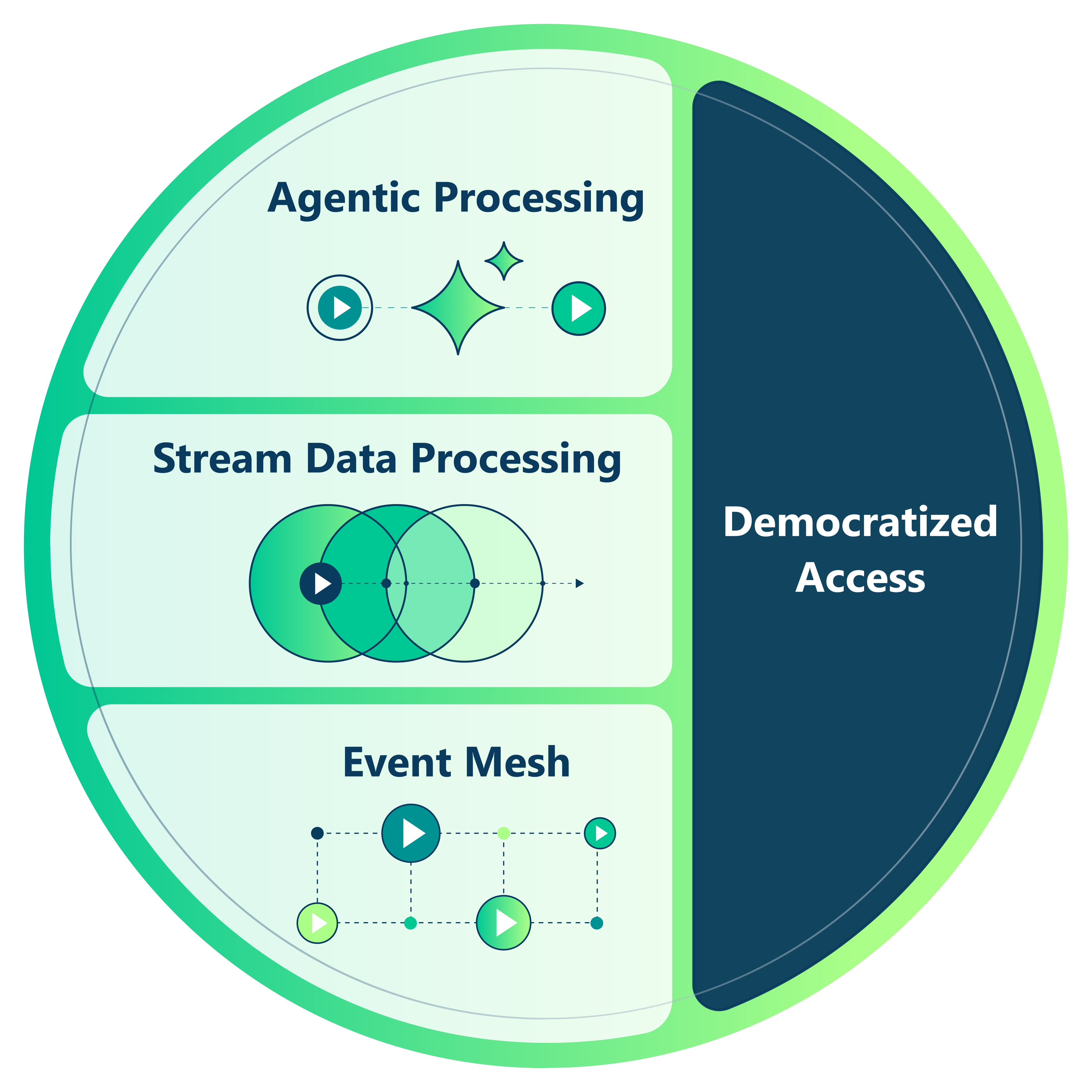
We’ve created one platform with three capabilities, built to work together. You can build an event mesh that connects everything — applications, agents, cloud services, partners and devices — across environments and geographies so events flow the instant they happen. Real-time stream processing turns events into context in milliseconds and delivers it to the agents that need it. And Solace Agent Mesh lets agents sense that context, decide, and act — with governance and observability built in, so you can run agents in production without losing control.
Where This Is Going
Analysts expect agents in large enterprises to grow from a handful to hundreds of thousands within a few years. These environments will demand real-time data at staggering scale. This isn’t hypothetical for us: our customers already move more than trillions of messages a day, including 188 billion in a single trading day at RBC with zero outages.
Those are the volumes we were built for.
Is this just another IT hype cycle? We’ve lived through a few, but this feels different. The telephone took 75 years to reach a hundred million users; ChatGPT did it in two months. Agentic AI is here and growing fast — the only question is whether your data is ready.
Real-time data is the missing ingredient for agentic AI, and we’ve been building toward it for more than twenty years — it’s why RBC, United Airlines, the FAA, Heineken, Bosch and hundreds more run their most demanding systems on Solace. The playbook is clear, and we’re working with those that are already aiming to run it.
Explore other posts from categories: Artificial Intelligence | Company

Denis King is Solace’s president and chief executive officer. After kicking off his career with Celestica, which was acquired by IBM, and Newbridge Networks, which was acquired by Alcatel, Denis joined Solace when it was a startup to help build the ground-breaking technology that introduced event-driven architecture to the financial services and telecommunications industries.
Since that time, Denis has been instrumental in leading the proliferation of EDA across industries and spurring Solace’s success, having held successive leadership positions as the company’s VP of systems engineering, SVP of global field operations, chief product officer and chief operating officer. Denis earned a bachelor’s of science degree in electrical engineering from the University of New Brunswick.

Denis is a member of the Forbes Tech Council, where he shares his expertise on real-time computing, digital transformation and event-driven architecture.



Subscribe to Our Blog
Get the latest trends, solutions, and insights into the event-driven future every week.