Fix What’s Holding Your Kafka Estate Back

Not Truly Real-Time (Polling Latency)

The Kafka Challenge

Your “real-time” apps aren’t truly real-time. Kafka’s pull-based model forces consumers to poll for data, introducing baseline latency and wasting compute cycles when no messages are available.

Impact

  • Time-sensitive actions arrive too late to matter
  • Customer experiences feel sluggish
  • Cloud costs rise from constant polling

The Solace Advantage

Push-based delivery with sub-millisecond latency. Events are delivered instantly when produced—no polling, no wasted cycles, no artificial delay.

Improvement

10–20× faster response times for real-time operations

Topic Sprawl & Partition Management Headaches

The Kafka Challenge

As use cases grow, topic counts explode. Teams must plan partitions, manage rebalancing, and navigate an ever‑expanding maze of topics just to keep systems running.

Impact

  • DevOps teams consumed by infrastructure tuning
  • Feature delivery slowed by topic planning
  • Rebalancing events cause instability

The Solace Advantage

Hierarchical topics with wildcard subscriptions. A single structured namespace supports thousands of use cases through fine‑grained filtering—no partitions to manage.

Improvement

Up to 90% less topic management overhead

Complex Multi-Environment Architecture

The Kafka Challenge

Moving data across clouds, data centers, and edge sites requires replication mechanisms such as MirrorMaker, cluster links, and ongoing operational management. Architectures become brittle and hard to operate.

Impact

  • Multi‑cloud initiatives slow or stall
  • Edge deployments need scarce expertise
  • Disaster recovery remains manual and risky

The Solace Advantage

Event mesh with dynamic routing. Data flows automatically across environments via optimal paths, reaching only locations with interested consumers.

Improvement

Deploy distributed architectures in hours, not months

No Support for Agentic AI

The Kafka Challenge

AI agents need real‑time context and asynchronous coordination. Kafka’s batch‑oriented model forces teams to build custom orchestration layers and state management from scratch.

Impact

  • AI initiatives delayed by platform limitations
  • Development costs escalate rapidly
  • Agents struggle to react to live events

The Solace Advantage

Native Agent Mesh platform. Agents subscribe to events, publish actions, and coordinate in real time using enterprise data streams.

Improvement

Production‑ready agentic AI deployments in weeks

Protocol Lock-In & Integration Challenges

The Kafka Challenge

Organizations run heterogeneous systems using MQTT, JMS, REST, and more. Forcing everything through Kafka requires connectors, adapters, and translation layers.

Impact

  • Integrations become long, expensive projects
  • Legacy and IoT systems remain isolated
  • Developer productivity suffers

The Solace Advantage

Native multi‑protocol support. Diverse systems connect using their preferred protocols while the platform handles routing and interoperability.

Improvement

Integrate new systems in days instead of months

High Total Cost of Ownership

The Kafka Challenge

“Free” software carries significant hidden costs: specialist staffing, large clusters, and constant compute consumption.

Impact

  • Rising cloud and infrastructure spend
  • Dependence on scarce experts
  • Operations teams stretched thin

The Solace Advantage

Operational efficiency by design. Push delivery reduces compute use, fewer nodes are required, and built‑in tooling lowers support burden.

Improvement

40–60% lower total cost of ownership over three years

Weeks of Configuration & Tuning

The Kafka Challenge

Getting to production requires extensive configuration—partitions, replication, retention policies, and environment setup—often repeated for every deployment.

Impact

  • Slow time to value
  • Projects blocked by environment readiness
  • Configuration errors cause outages

The Solace Advantage

Production-ready quickly. Intelligent defaults and automated provisioning enable rapid deployment across cloud, Kubernetes, or on‑premises environments.

Improvement

New environments live in minutes instead of weeks

Limited Observability & Governance

The Kafka Challenge

Understanding system behavior requires stitching together multiple monitoring and governance tools, leaving teams without a unified view of event flows.

Impact

  • Incidents take longer to diagnose
  • Compliance and audits become difficult
  • Data ownership and lineage are unclear

The Solace Advantage

Unified observability and governance. A single portal provides discovery, visualization, metrics, and audit capabilities across the entire event landscape.

Improvement

Up to 70% faster incident resolution (MTTR reduction)

Ready to see how Solace can solve your Kafka challenges?

Book a Personalized Consultation

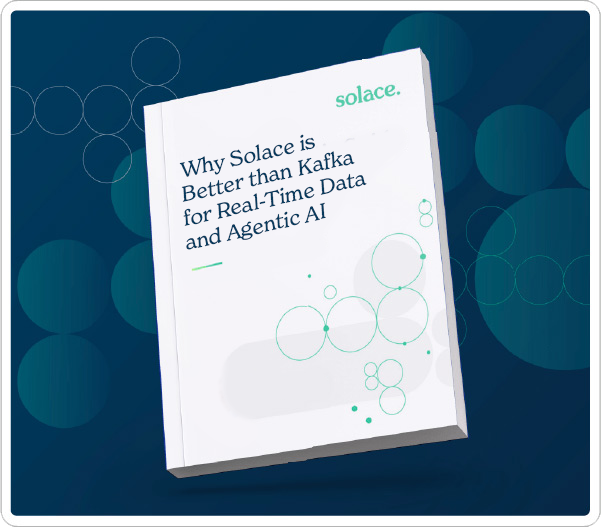
Want to dive a little deeper first? Read this detailed comparison.

Why Solace is the Best Kafka Alternative

Solace Platfrom for Agentic AI

Agentic AI

Solace Agent Mesh makes it easy to build agents, feed them the real-time context they need, and orchestrate their actions.

Smart Topics

Hierarchical topics with support for wildcards enable precise delivery to many subscribers via fine-grained subscriptions — without topic sprawl.

Dynamic Routing

Solace automatically routes information across clouds and datacenters via the best path, and only across long-distance links with subscribers at the other end.

APIs & Protocols

Support for popular protocols like A2A, AMQP, JMS, MCP, MQTT, REST, and WebSocket let your team integrate apps and agents using the best method for each interaction.

Kafka Integration

Solace is interoperable with Kafka via a built-in bridge so you can extends Kafka data streams into real-time operations without replacing existing pipelines.

How Solace Compares to Kafka

Why enterprise application and integration teams choose Solace for real-time data and agentic AI.

 SolaceKafka
Architecture
  • Event broker / event mesh (asynchronous, decoupled, real-time)
  • Distributed Log
Delivery Model
  • Publish/Subscribe (event-driven, immediate, push)
  • Consumer Pull (consumers poll the broker on a configurable interval.)
Latency
  • Very low, predictable
  • High, Unpredictable
Topics
  • Smart: Hierarchy and wildcards
  • Flat; no hierarchy or wildcards, so sprawl at scale
Filtering & Routing
  • Broker-side filtering, dynamic routing
  • Client-side (wasted bandwidth)
Protocol Support
  • Many (MQTT, AMQP, JMS, REST, WebSocket, Kafka)
  • Kafka only (requires adapters for other protocols)
Agentic AI
  • Built-in agent creation and orchestration
  • Not designed for agentic AI (requires custom build)
Reliability/Robustness
  • Built-in FT and HA, with active/standby, auto matic fast failover
  • HA requires configuration, tooling, and tuning
Scaling
  • Lightweight, horizontal scaling
  • Partition rebalancing complexity
Time to Production
  • Very Fast
  • Weeks of configuration + tuning
TCO
  • Low
  • High (need for dedicated teams)

Ready to learn more?

Read the Whitepaper

Read the Whitepaper

Book a Consultation