


What’s Holding Your Confluent Deployment Back?
Confluent Pricing at Scale
Lock-In Across Your Enterprise Stack
Managed Kafka with Proprietary Dependencies
Limited Native Support for Agentic AI
Fan-Out Compute Overhead
Connecting Beyond Kafka Requires Adapters
Multi-Cloud and Hybrid Streaming Complexity
Why Enterprises Choose Solace Over Confluent
Kafka was built for appending logs. Confluent added a connector layer to enable streaming. Solace was built for moving data in real-time — and has added an integration layer to enable streaming. That architecture more closely matches the needs of 2026: efficient RAG pipelines, agentic AI, and operational real-time data.
And it’s all part of a proven platform with best-in-class support.
One platform, built by one team — focused entirely on real-time event streaming.

Event-Driven Architecture
Queue-based event mesh delivers efficiency that’s hard to achieve with a log-based structure.

Lower TCO
Predictable pricing, broker-side filtering, and push-based delivery reduce compute waste.

Built for Agentic AI
Dynamic wildcard subscriptions let AI agents subscribe to precise events in real time — without repartitioning. Native Agent Mesh orchestration.

Multi-Protocol
Connect legacy, cloud, and IoT without adapters thanks to support for AMQP, JMS, Kafka, MQTT, REST, and WebSocket.

Any Environment
Every cloud and technology treated as a first-class citizen — no proprietary lock-in. Cloud, hybrid, on-prem, edge — one platform.
Solace vs Confluent: Side-by-Side Comparison
| Features | Solace | Confluent |
|---|---|---|
| Architecture | Event-driven, Queue-based, event mesh | Log-based, distributed Kafka |
| Delivery Model | True real-time publish/subscribe | Pull-based delivery |
| Broker-Side Filtering |
|
|
| Dynamic AI Subscriptions |
|
|
| Kafka Compatibility |
|
|
| Schema Registry | Yes | Yes |
| Pricing Model | Simple, predictable, lower production costs | Per-partition + per-connector |
| Multi-Protocol | MQTT, AMQP, JMS, REST, WebSocket, Kafka | Kafka only (adapters required) |
| Hybrid / Multi-Cloud |
|
|
| Agentic AI |
|
|
| Support Model | Best-in-class, single product focus | IBM enterprise support model |
| TCO (3-year) | Lower (varies by workload) | Varies; may require specialist staffing |
| Ownership | Independent, 100% EDA-focused | Part of IBM |
Most mature enterprises will run both — Kafka for replay and cold-archive domains, and Solace as the operational routing layer and AI-integration bus.
How Solace Compares to Other Confluent Alternatives
There are many alternatives to Confluent — from self-hosted Apache Kafka to Redpanda, Amazon MSK, and Aiven. Most replace the managed Kafka layer. Only Solace replaces the entire middleware strategy.
Self-Hosted Apache Kafka
Full control, high operational burden.
Solace reduces partition sprawl and operational overhead with an integrated, enterprise-grade platform.
Other Managed Kafka: Amazon MSK, Azure Event Hubs, Aiven
Cloud-native Kafka replacements, good for single-cloud workloads.
Solace delivers true multi-cloud, multi-protocol event mesh without cloud lock-in.

Redpanda
Kafka-compatible drop-in, lightweight.
Solace goes further: multi-protocol, agentic AI, event mesh, enterprise support, and a proven migration track record.
Why Solace Wins for Enterprise-Grade Confluent Displacement?
Flexible options to meet the precise requirements of your use case — while comprehensive enough to future-proof your enterprise.
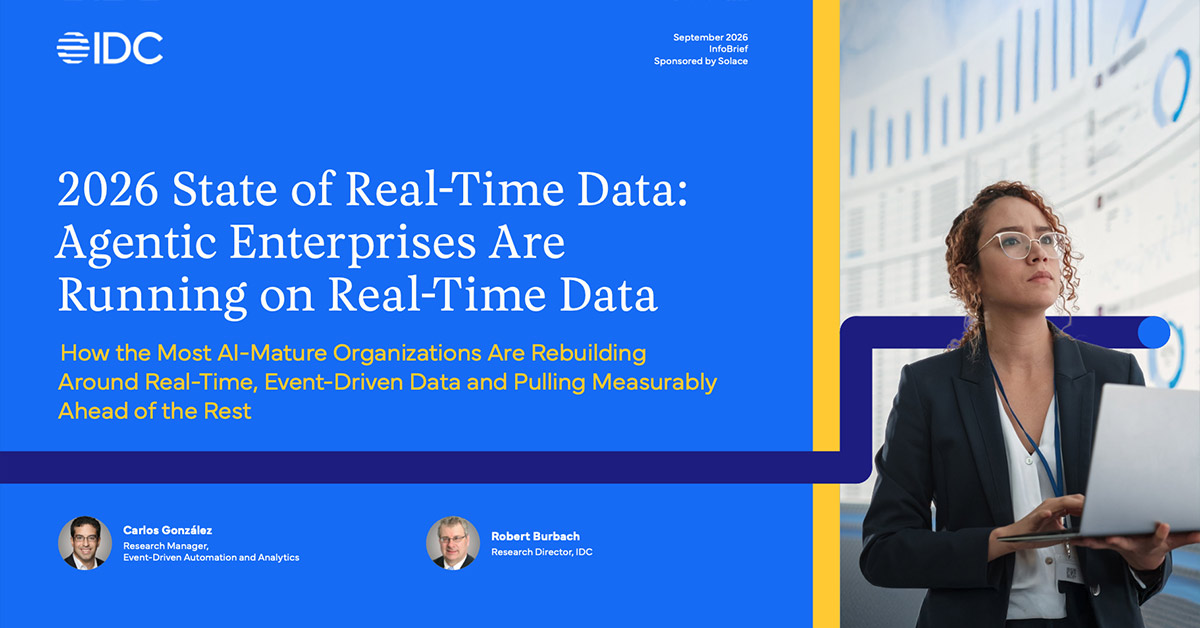
2026 IDC STUDY
Picking a streaming platform?
IDC ranked real-time data connectivity the #1 barrier to scaling AI agents, ahead of model quality and cost.
Recognized for Driving the Future of Real-time Data



Customers Benefiting from Unified
Management of APIs and Events
Switching from Confluent to Solace Is Easier Than You Think
Moving major middleware is high-risk and high-cost — we know. That’s why Solace has a proven process, a decoupled architecture that supports transformation, and services and partners to help you effect it with low risk.
-
Assess
Map your Confluent topics, connectors, Schema Registry usage, and IBM lock-in exposure.
-
Connect
Solace’s Kafka-compatible bridge connects existing producers and consumers without code changes. Your Kafka investments don’t disappear — they get a role that fits their architecture.
-
Expand
Progressively unlock multi-protocol, agentic AI, wildcard subscriptions, and event mesh across hybrid/multi-cloud environments.
Interactive Product Tour
See Solace in Action
Click through the Solace Platform at your own pace.
See how broker-side filtering, dynamic subscriptions, and the event mesh work in practice, and how they compare to what you’re running on Confluent today.
Related Resources


Frequently Asked Questions About Confluent Alternatives
With Confluent now owned by IBM, some teams are reassessing roadmap direction and pricing as those decisions move under IBM. Solace is a leading independent alternative — with a proven track record and a platform focused entirely on real-time event-driven architecture (EDA). Evaluating alternatives early gives teams time to plan ahead of renewal decisions.
Confluent’s per-partition and per-connector pricing can compound at scale, and fan-out costs grow when many consumers read the same topic but use only part of the data. Solace’s broker-side filtering and push-based delivery are designed to reduce that overhead, which can lower total cost of ownership over time.
Confluent is a managed Kafka service built on a log-based architecture — optimized for data pipelines with a pull-based delivery model. Solace is an event mesh built for real-time data movement, with native multi-protocol support, dynamic AI subscriptions, and broker-side filtering. Where Confluent centers on the Kafka and IBM ecosystem, Solace is designed to connect across many technologies.
No. Solace’s Kafka-compatible bridge means existing producers and consumers connect without code changes. Most mature enterprises run both — Kafka for replay and cold-archive domains, Solace as the operational routing layer and AI-integration bus — and consolidate over time.
Yes. Solace Cloud is fully managed on AWS, Azure, and GCP. Unlike Confluent Cloud, Solace also supports on-premises and hybrid event mesh deployments from the same platform — giving you flexibility without forcing a cloud-only commitment.
For pure Kafka log pipelines, Confluent is capable. For enterprise-grade real-time data movement across multiple protocols, hybrid clouds, IoT, and agentic AI — with proven deployment in global financial markets and large-scale IoT networks — Solace is often the stronger strategic platform.